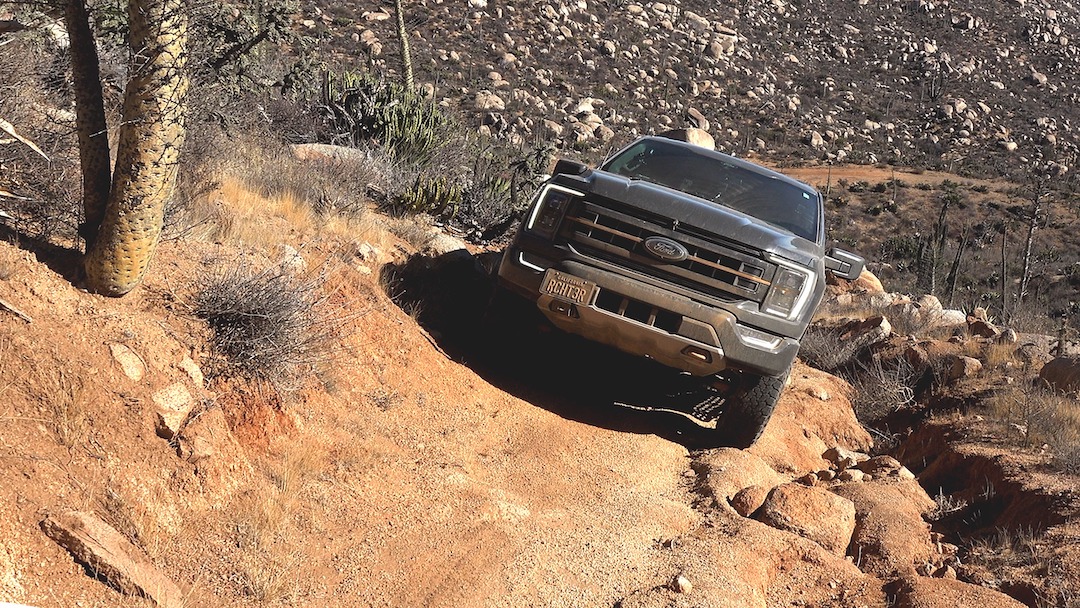
Day 9 in Baja, on the Red Line, moments before the trail edge gave way.
We were on the red line, where we shouldn’t have been. A boulder and steep hillside to the right. No room to move in that direction. To the left, inches from the wheels, a washout that sliced through the trail with an unsurvivable drop on its other side. We were stopped cold, and our top-heavy rig was far closer to terminal roll angle than either of us cared to be. The place was new to me. The feeling was not.
Derek, my teammate on the expedition and the film’s associate producer, was leaning out the window searching for a few safe inches the tires could occupy. Every option ended with us not going home. “What do you think? What’s the move?” he asked. “I don’t know” was all I had. I saw no safe line.
We were in Baja, nine days into a ten-day off-road expedition with no official support or rescue teams, shooting our film, Into Uncertainty. A month earlier, when the whole thing was still just an idea, Derek and I had each gone home and talked to our families about it, on camera.
I had been working with Derek in Sacramento on disaster recovery projects and flew back to Florida for Christmas. Before shipping my camera gear west, I used it to interview my family. A pair of Sony FDR-AX700s on sticks, wireless mics, a GoPro for the wide, natural light, no crew.
For my dad, the dock along the Intracoastal in northwest Florida. For my mom, her condo balcony with her plants and her Buddha statue beside her. For my brother, his garage workshop, his classic Mustang and an engine on a stand behind him. I picked places that would not look great on camera but where each of them would feel at ease. That was deliberate, and none of them knew why. I told them I wanted their thoughts on what the BajaXL might be like, then sat them down somewhere comfortable with nothing in the room to remind them a film was being made.
My mom, Lynne, asked how she felt about me taking on the BajaXL: “Absolutely terrified and absolutely jealous that you’re doing it.”
Eric, my big brother and best friend, thought back to the adventures that drove our parents mad when we were kids. “Testing yourself physically, mentally. We’ve been four-wheeling a lot. Hours and hours and hours for days on end. Haven’t done that before.”
Hank, my father and philosophical sounding board, wore an FDNY job shirt though his own career was in Atlanta, and said what a firefighter would say. “Vehicles that can break down, and people that can break down.”
The interviews turned conversational. They forgot the cameras as I asked why they thought I was doing this, what the risks were, and what they hoped I would get out of it. By the end of each one it was clear that, risks and all, my family wanted this for me. They hoped I would find whatever it was I needed to find.
“I don’t know what you’re going to find,” my dad said, drifting toward the philosophical. Eric named a side of me few people ever see: “Soul searching. It’s the restless spirit within, the deep down inside, the inner bear.” My mom, the one I have always gone to when trouble and I found each other, has watched me take my own path whether or not it lined up with anyone else’s idea of a normal one. “I think you’ve already found what you need to find in life, Ryan. And it will become even more wonderful for you.”
The family interviews were half the plan. Derek and I wanted the same honesty from each other, captured before Baja, for the film or just as a record we could look back on in post. Then, a couple of weeks before we were set to leave, fires tore through the Los Angeles area and we were deployed. Everything left on the Baja list went on hold.
On our last night in Los Angeles, with one camera, a GoPro and a single portable light Derek had thrown in his truck, we turned my hotel room into a studio. It was the Bonaventure, where part of Interstellar was shot, so we ate steak at LA Prime and went looking for the locations first. Then we sat down. We had one day to get back to Sacramento and finish an unfinished rally truck that also had to be a ten-day rolling film set.

We held little back, trading seats behind and in front of the lens. The LA skyline in the background. Bad focus chasing the changing light. Poor sound without proper mics, but honest. We asked each other hard questions about our past and about how ready we really were for what we were about to throw ourselves into. Some of that footage is in the film, raw and unvarnished.
“How do we commit ourselves to something? And it’s a lofty goal. And every step of the way is gonna be tough. But we’re gonna do it, no matter what… No matter what,” Derek said, his eyes glazing over as it sank in.
“We don’t know what’s going to happen on this trip. We don’t know what we’re going to encounter out there. And we’re grossly underprepared. And we’re not even in the city we need to depart from. That should be looked at as a problem,” I said when it was my turn.
Leaving people who had just lost their homes, for a personal journey, weighed on us both. But we had been planning Baja for months, and if we let this window close we knew it would never open again.
The next day in Sacramento we finished what we could. Most of the plan was already on the cutting room floor and we had not yet set foot in Mexico. The last stop before Baja was Derek’s house. He had been gone for weeks on the LA response and came home to his pregnant wife and two young daughters for a single day before leaving again. I slept on his couch. We started early.
I kept a GoPro running so the goodbye could happen without a camera in anyone’s face. The girls had no idea it was there. They just wanted to hug their daddy before his “adventure.” They were too young to know what that meant.
Johanna knew. She looked straight through the lens and spoke to me. “You take care of him.” Then she turned to Derek. “And you take care of him.” She sent the girls over: “Go give Ryan a hug. Say, have fun on your adventure!” And as I hugged those kids and thought about what Derek was risking, she added, “Say take care of daddy.” They did, and I promised those little girls I would. Neither of us understood the weight of that promise until we were deep in Baja.
It came late in the trip, after Baja had already changed us, in what became the turn into the film’s third act.
All of it is on screen. The red line on the GPS, drawn for something other than four wheels. The tension building as the danger grew and the truck slowed. No help in sight. No one answering the radio. The fear in our voices. It was an easy sequence to cut because it was real.
Then the trail edge starts to crumble. A few grains of sand at first, then the front wheel follows. Nothing left to grip as the edge sloughs into the washout. As the truck begins to slide, the screen goes black and a crashing sound punctuates the moment.
The black frame and the sound were the choice. Let the tension build and build, and then let the worst-case scenario happen. Hold the darkness as the crash fades. Hold it just long enough for the audience to fill it with their own worst outcomes. That is where the cut goes: on the far side of the fear, not the far side of the slide.
I was a firefighter for nearly twenty years, then moved into emergency management, and took up filmmaking alongside it. Years of being close to people on the worst days of their lives taught me something most people would rather not accept. Tragedy, danger and consequence are not avoidable. There was no version of this expedition in which we were spared. At some point something would come along with the power to break us, mentally or physically, or worse.
The hard part of making an unscripted film in which every plan falls apart is capturing the moment consequence arrives.
That is the real reason I interviewed my family, and the real reason I shot those interviews the way I did, with no pretext and nothing to perform for. I knew there would be a moment of real fear on this trip, and that in that moment Derek and I would think about everything we had left behind, the people who loved us and depended on us. I wanted the audience to feel that with us, and I wanted it to be true. Their fears and their hopes had to be recorded before any of it happened. It could not be reverse-engineered after the fact. Not honestly.

None of it could have been captured had we chosen to shoot this film “properly.”
Derek’s hand on his wife’s belly as we loaded up to leave.
His girls asking me to take care of daddy.
My family imagining what Baja might be like.
My dad, on the dock, along a stretch of water I have fished with him, my brother and my grandfather since I was the age of Derek’s girls: “The discussion I’m looking forward to. What did you find between right now, at this moment, and the now when you’re done with this?”

Ryan G. Christen is an independent filmmaker and former Battalion Chief whose work looks at the point where preparation ends and uncertainty begins. After more than 25 years in emergency response and disaster recovery across 27 states, he directed Into Uncertainty, his feature debut, shot inside the 2025 BajaXL rally and finished single-handedly through his company, RGC Media Inc.
Related