
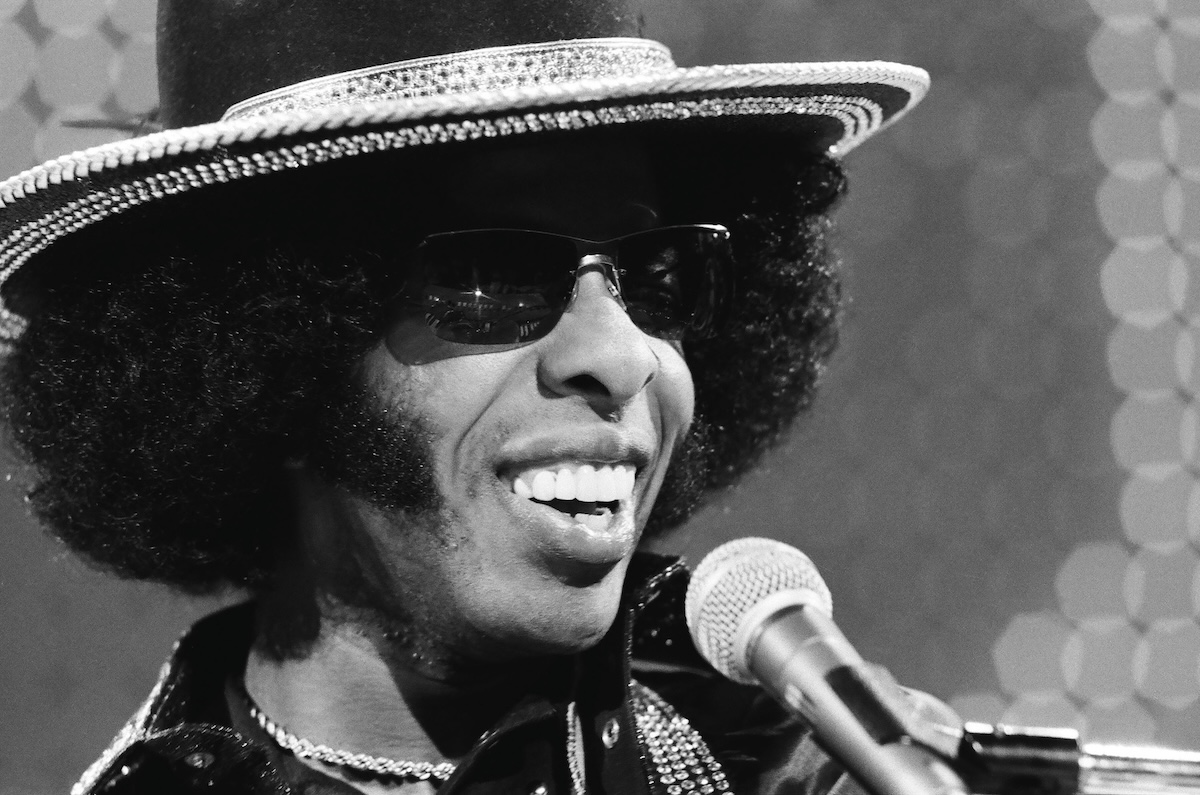
Sylvester Stewart was born in Texas in 1943 but spent most of his life in California, where he became one of the icons of San Francisco’s ’60s counterculture. The wildly talented songwriter and multi-instrumentalist released singles on small independent labels as Danny “Sly” Stewart, Sylvester Stewart, Sly Stewart, or simply Sly from 1961 to 1965 before becoming better known as Sly Stone, at first as a popular radio DJ on KSOL. He produced hits for Bobby Freeman and the Beau Brummels, and even the first recording of “Somebody to Love,” the song that would launch Jefferson Airplane to fame, for Grace Slick’s earlier band the Great Society.
In 1966, Sly Stone and his brother Freddie Stone, who led his own band, pooled together the best musicians they knew to form Sly and the Family Stone. As one of the first mainstream bands with a diverse mix of Black, white, male, and female musicians and a unique fusion of R&B and psychedelic rock, Sly and the Family Stone became an irrepressible force. After scoring a string of pop hits like “Dance to the Music” and “Everyday People,” Sly and the Family Stone achieved ’60s immortality as one of the star attractions at Woodstock.
In 1969, Sly and the Family Stone released three classic songs from the initial sessions for the band’s fifth album: “Thank You (Falettinme Be Mice Elf Agin),” “Hot Fun in the Summertime,” and “Everybody is a Star.” As Stone missed deadline after deadline for the album, though, Epic Records collected those songs on a 1970 Greatest Hits album that remains the band’s best-selling release.

Stone finally returned with his most provocative and experimental album, 1971’s There’s a Riot Goin’ On. Most of the classic Family Stone lineup left the band by early 1975, and Stone’s behavior became more erratic as he struggled with addiction. He released little new music after 1982, and his public appearances became more sporadic.
Questlove’s award-winning 2025 documentary Sly Lives! (aka The Burden of Black Genius) closely examined Stone’s complicated life and remarkable career, featuring interviews with several members of the Family Stone but not Sly himself. Sly Stone died on June 9, 2025 at the age of 82. A year later, let’s look back at the enormously important catalog he left behind, both with the Family Stone, as well as two albums for which he was billed as a solo artist.
12. I’m Back! Family & Friends (2011)

There are three excellent new tracks on I’m Back! Family & Friends, including the talkbox funk workout “Plain Jane” and “Get Away,” a minimal groove reminiscent of the There’s a Riot Goin’ On era. But the only album Sly Stone released in the last 40 years of his life, nominally a solo album, is otherwise disappointingly devoted to revamping his group’s old hits. Versions of “Dance to the Music” with organ by Ray Manzarek of the Doors and “Everyday People” with vocals by Heart’s Ann Wilson are pleasant if not essential, while “Family Affair (Dubstep Mix)” and “Thank You (Electro Club Mix)” could be avoided altogether.
11. Heard Ya Missed Me, Well I’m Back (1976)

The Family Stone’s classic lineup disbanded after a poorly attended 1975 show at Radio City Music Hall. Sly Stone resumed releasing albums under the group name the following year, with mostly different musicians aside from trumpeter and vocalist Cynthia Robinson, who’d recently given birth to Stone’s daughter Sylvyette. There are some arresting moments like the rapid hi-hat cymbals and gurgling synth bass of “Mother is a Hippie.” But Heard Ya Missed Me, Well I’m Back hastened Stone’s commercial decline, missing the Billboard 200 entirely.
10. Ain’t But the One Way (1982)

After Sly Stone guested on Funkadelic’s 1981 album The Electric Spanking of War Babies, he and George Clinton attempted to make an entire collaborative project. Stone and Clinton were both in throes of drug addictions and had a falling out before the album could be completed. Producer Stewart Levine salvaged the sessions, turning the material into the last Sly and the Family Stone album. The funked-up cover of the Kinks’ rock classic “You Really Got Me” is surprisingly good, but Ain’t But the One Way is a frustrating remnant of an unrealized summit of two legends.
9. Back on the Right Track (1979)

It should be clear from the trio of albums with the word “back” in the title that Sly Stone tried very hard to stage a comeback before he turned into a recluse. While Epic issued a remix collection called Ten Years Too Soon that put a disco sheen on Sly and the Family Stone’s early hits in 1979, Stone jumped to Warner Bros. and issued a set of new songs that were defiantly unconcerned with the trends of the day. With a running time of only 26 minutes, Back on the Right Track is a short album but not a slight one, with Stone reflecting on his turbulent life’s ups and downs on spirited but reflective songs like “Who’s To Say” and “Remember Who You Are.”
8. Small Talk (1974)

Stone appears on the cover of Small Talk with Kathleen Silva and their son Sylvester Jr. Aside from the hard funk of “Loose Booty,” it’s arguably Stone’s mellowest album, a tribute to domestic bliss with lush violins by new member Sid Page and nostalgic grooves like the doowop pastiche “This Is Love.” Two months after the album’s release, Stone and Silva married onstage at Madison Square Garden during a sold-out concert. But it was partly a publicity stunt to prop up the band’s flagging popularity, and “Time For Livin’” was their last Top 40 hit. “Although you can hear different, you’d almost think Sly’s sense of rhythm had abandoned him, because his first flop is a bellywhopper,” Robert Christgau wrote in the Village Voice review of Small Talk.
7. A Whole New Thing (1967)

San Francisco had the hottest rock scene in America in 1967 thanks to the emergence of Jefferson Airplane, the Grateful Dead, and Big Brother & the Holding Company. Sly and the Family Stone would join those bands on the charts soon enough, but their debut was released just after the Summer of Love to public indifference. In the decades since the album’s release, “Trip to Your Heart” has found immortality as the basis of LL Cool J’s classic “Mama Said Knock You Out,” and “Underdog” was used to great effect in the opening of Edgar Wright’s 2025 film The Running Man. The unruly and energetic A Whole New Thing, recorded live in the studio, does remain a little overlooked, the only one of the Family Stone’s ’60s albums that isn’t featured on Greatest Hits.
6. High On You (1975)

By 1975, radio airwaves were full of bands that were heavily influenced by Sly Stone, Parliament, the Ohio Players, and Earth Wind & Fire, as well as former Family Stone bassist Larry Graham’s Graham Central Station. Stone’s first album as a solo artist didn’t capitalize on that zeitgeist commercially, but High On You manages to be both breezy and inventive, with novel textures like the nasty fuzz bass on “Who Do You Love?” and “So Good To Me” and sweet pedal steel on “Le Lo Li.” The single “Crossword Puzzle” is probably best remembered today for being sampled on De La Soul’s “Say No Go.”
5. Life (1968)

Singer/keyboardist Rose Stone, arguably the band’s most recognizable voice besides Sly himself, became the fourth Stone sibling to join the band on the Family Stone’s third album. Life isn’t as packed with hits as the albums that directly preceded and followed it, and songs about scene politics like “Jane Is a Groupee” and “Plastic Jim” aren’t Sly Stone’s most thought-provoking lyrics. But it’s a great showcase for drummer Greg Errico, who lays down driving grooves for crate diggers of the future on “Love City” and “Fun.”
4. Dance To The Music (1968)

It’s not the most romantic story in the music business, but it’s happened time and time again: Veteran label executive Clive Davis pressures a low-selling act to make a more commercial record, and the hits start coming. Side 1 of Dance To The Music opens with the title track, a three-minute blitz of hooks that landed the Family Stone on the pop charts. And it closes with “Dance to the Medley,” a 12-minute tour de force of the kind of psychedelic jams that made the band one of the hottest tickets on the touring circuit.
3. Fresh (1973)

Larry Graham was kicked out of the Family Stone in 1972 and Fresh includes the last two tracks he recorded with the band. But bass remained central to their sound, and Sly Stone himself lays down some of the album’s funkiest bass licks on “Frisky” and “Skin I’m In.” You could look at the even-numbered Sly Stone albums from the first decade of his career as more accessible takes on the sound of the previous odd-numbered album. Fresh, for instance, builds on the leftfield aesthetic of There’s a Riot Goin’ On with brighter tunes and warmer sentiments. “If You Want Me to Stay” missed the Top 10 at the time, but it’s grown in stature over the years and is now right behind “Everyday People” as the band’s second most popular track on Spotify.
2. Stand! (1969)

Sly and the Family Stone’s more commercial ’60s work can be seen as far more utopian and idealistic than their darker ’70s albums. But Stand! is about as nuanced and heterogenous as a pop blockbuster can be, and the album’s first four songs alternate between inspirational anthems and more barbed sentiments. There are multiple songs that could be (and were) covered by the Jackson 5 without scaring the teenyboppers, but Stone’s musical and lyrical depth is right there in the band’s most accessible album. “Stand! is not simply a polemic. It’s also extremely vital body music,” Alec Dubro wrote in the Rolling Stone review.
1. There’s a Riot Goin’ On (1971)

The Family Stone’s first four albums were recorded and released in under two years, and then the fifth album alone took longer than that to deliver. The band itself was fraying, with Stone recording much of the murky, druggy album in the attic of his Bel Air mansion. By himself or with a coterie of other troubled legends like Billy Preston and Ike Turner, Stone constructed some of the earliest drum machine-driven pop hits on his Maestro Rhythm King MRK-2. Family Stone manager David Kapralik came up with the tagline for magazine ads that fed into the intrigue around the album: “2 ½ years is a short time to wait for a work of genius.” The gambit worked, with There’s a Riot Goin’ On becoming the band’s only No. 1 album, and “Family Affair” their third and by far strangest No. 1 single, traded in live band grooves for a prickly lo-fi feel and a conversational, close mic’d vocal. Sly Stone famously titled the album as a response to Marvin Gaye’s What’s Going On, and those 1971 releases stand tall today as two very different monuments to the creative and political possibilities of soul music.