
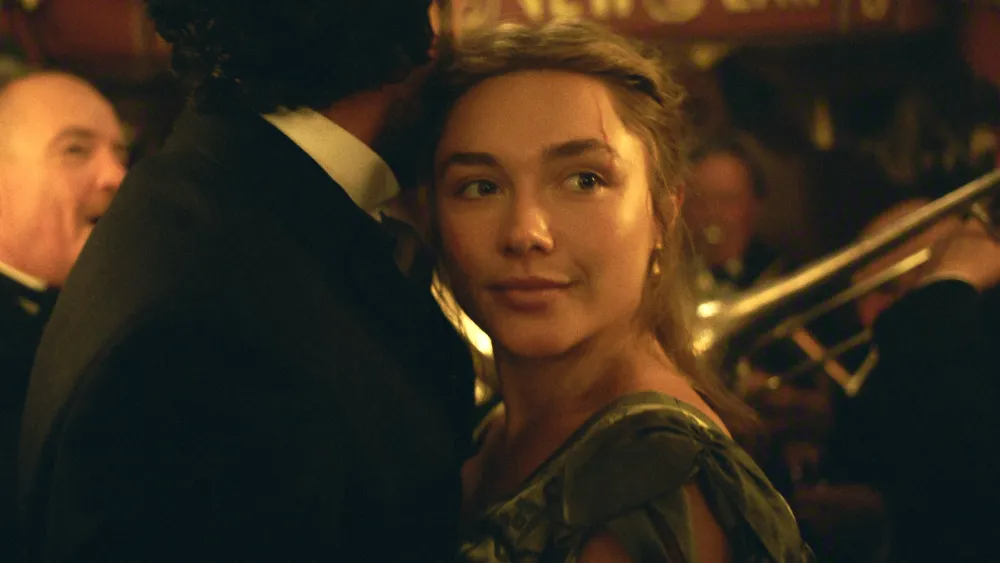
The combination of your writing and Florence’s performance makes your interpretation of Cathy particularly hard to pin down, because she is so mercurial by nature, especially toward the final years of her life as this madam of a brothel. How did you think about scripting Cathy’s descent into madness?
Steinbeck kept a journal while he was writing this book. He wrote longhand on these big ledger books. He wrote his pages for the day on the right-hand side, and he would write letters to his friend and editor, Pascal Covici, on the left-hand side. Those letters were published, and I weirdly had read them already when I started adapting this, but I used those letters as a real North Star for me in understanding Steinbeck’s intentions. One of the things that’s really clear to me is that his viewpoint of her changed as he wrote. He goes from saying, “Oh, I’m going to write a monster unlike any you’ve ever seen,” to saying, “I think we all have a little monster blood in us, and people will hate her not because she is foreign, but because she is familiar.”
I don’t have any proof for this, but I think he didn’t know what to do with that empathy. I think it surprised him — maybe it crept up on him. One of the things I see in the second half of the book is that he starts to really punish her. It’s like he doesn’t know what to do with her, really. He starts being really mean about her physical appearance, which I get is a manifestation of her evil. But because he’s filled with empathy and understanding for her by this point in the book, it felt to me a little bit underdeveloped. I was curious about: What’s the more fully embodied version of what happens to Cathy? Why does she kill herself? How do we get there?
One of the things that really struck me was that this character is operating from the viewpoint that the world is full of folly and evil. This is a person who’s really isolated herself, who has run from love, who has thought of love as a trap, and who has done everything in her power not to be trapped. And here she is in her 30s, and she has no one she can trust because of how she’s built her life. In the book, she builds a little gray room with no windows that she can go in and close the door. For budget reasons, I had to not have her build this little room, but I tried to turn her whole bedroom into that room for herself. I thought about a world in which this person is carrying trauma and has had no access to anyone helping her with her mental health. I was also thinking about the morphine use that is implied in the story — she carries this little bottle of morphine around her neck — and I stepped off from there.
Courtesy of KIRSTY GRIFFIN/NETFLIX