A Super Mario 64 fan has performed an open-source computational analysis in an attempt to finally solve the game’s infamous ‘L is Real 2401’ mystery.
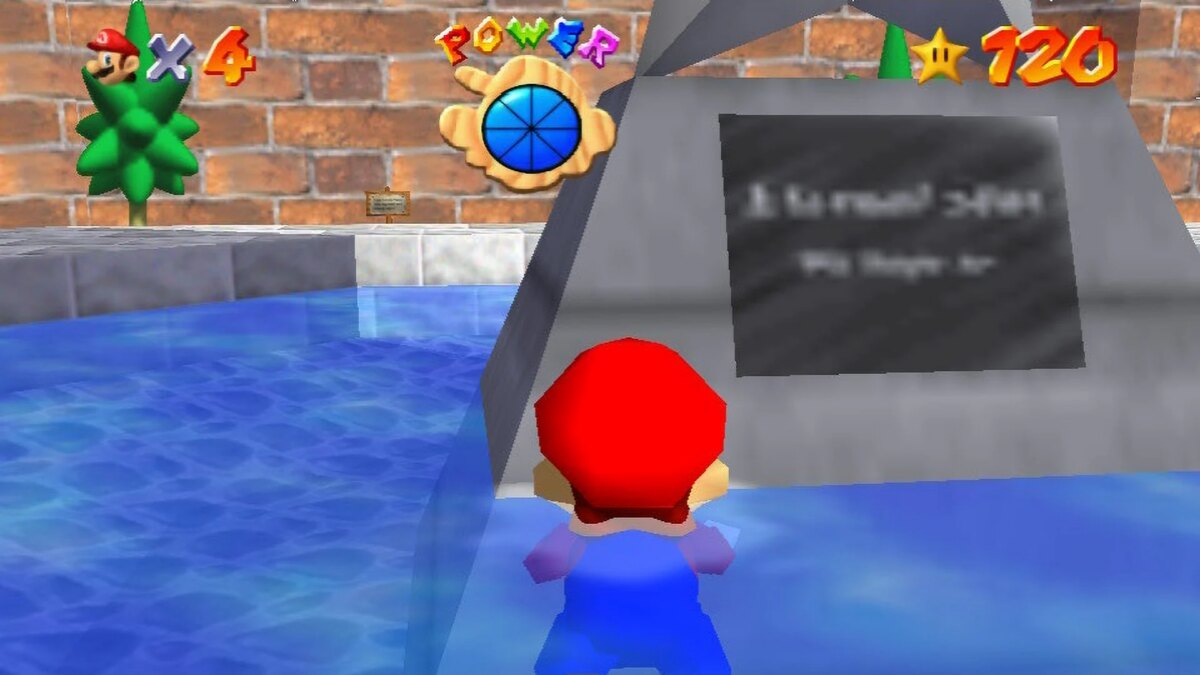
For around 30 years, players have tried to figure out what the plaque on the fountain in Peach’s Castle says in the 1996 Nintendo 64 launch game.
An early theory was that the plaque reads, ‘L is Real 2401’, a potential hint that Luigi might be playable in the game and that 2401 might be a clue on how to unlock him.
In 1996, IGN.com offered $100 to anyone who could figure out how to unlock Luigi, while in its April 1998 issue, Nintendo Power magazine mentioned the ‘L is Real 2401’ theory in an April Fool’s Day feature.
Modern re-releases of the game featuring sharper visuals haven’t made the answer any clearer, since the original plaque text was only written on a small 32×32 pixel tile.
Now programmer Mochi64 has performed a complex analysis on the plaque in an attempt to finally decode what it says, and made their results open-source for others to check.
According to Mochi64, because the two lines of text are 3-5 pixels tall, they’re too small to read, so any attempt to upscale the image is pointless because it’s just guesswork.
Instead, their process used millions of calculations to figure out what combination of words, font, and resizing technique that would have been performed by an artist in the mid-90s would have resulted in pixels closest to those in the plaque.
Using this process, Mochi64 believes the message actually reads ‘Eternal Star’ on the top line, and ‘We Hope So’ on the bottom line, because this provided the closest possible match after millions of comparisons.
Mochi64 applied a scoring system to their tool, which grades each word and phrase on how close a match it is to the original texture. After trying more than 1.2 million words, the above received the lowest (and therefore best) mismatch score of 1,129. By comparison, ‘L is Real 2401’ had a mismatch score of 2,031 on the first line alone.
Mochi64 has also posted a ‘plaque challenge’, where people can use the same open-source code to test another phrase and see if they can get an even lower score, but after their fairly exhaustive process they’re sure this is the definitive answer. As for what it actually means, Nintendo seems unlikely to ever confirm.
Mario 64 fans’ decades-long search for Luigi
Luigi was originally intended as a second playable character in Super Mario 64, according to a 1996 interview with director Shigeru Miyamoto, which is what sparked fascination with the game’s blurry sign.
Speaking via an official strategy guide, Miyamoto described “a room made of simple Lego-like blocks” in which “Mario and Luigi could run around in there, climb slopes, jump around, etc”. This seems to match YouTube footage from a 1995 expo appearing to show the two characters together.
According to Miyamoto, Luigi stayed in Super Mario 64 until the final year of development, after which they removed him due to memory issues.
“We were going to include him in a Mario Bros. style minigame, but because most users probably only have that one controller when they first buy their N64, for that reason (and others) we decided not to,” Miyamoto said at the time.
“I think it would have been great if we’d been able to make it two-player, with Mario and Luigi. But if we had done it wrong, it would have turned into a fighting game or something (laughs), so we’re leaving that challenge for next time.”
In a 2009 Iwata Asks interview, Miyamoto commented again on the canned Mario 64 multiplayer mode, saying: “The screen was split and they went into the castle separately. When they meet in the corridor, I was incredibly happy! (laughs) Then there was also the mode where the camera is fixed and we see Mario running away, steadily getting smaller and smaller.”
If authentic, the Space World 1995 footage is the first documented time Luigi has been seen in the classic N64 game, outside of a high-profile 2020 leak of classic Nintendo game files, which included a model for the character.