
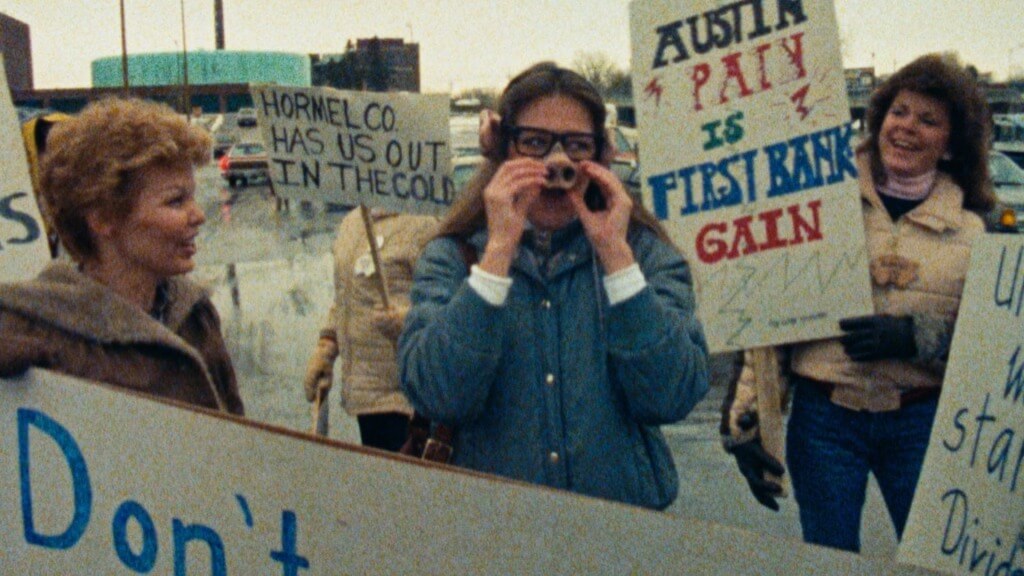
Director Barbara Kopple, one of the leaders in the field of documentary filmmaking, has been on the frontlines recording the American labor movement since her groundbreaking 1976 feature debut Harlan County, U.S.A. Following the struggles of a coal miner’s strike in Kentucky, Kopple found a story of community solidarity and corporate cruelty––a struggle of David and Goliath proportions. About a decade later, she drove to Austin, Minnesota, to film a new strike at a Hormel meatpacking plant. Kopple found workers pushed to the brink, disagreements among labor leaders, and corporate interests that only focused on increasing profitability, not wages. The result would become 1990’s American Dream, a documentary just as relevant today as it was during its original release.
Now, American Dream is coming to theaters this Friday with a new 4K restoration for May Day, playing alongside Harlan County, U.S.A. The two Oscar-winning documentaries reflect the change in the American labor movement as support for unions fell and workers felt their paychecks shrink under Reaganomics, while still resonating with working conditions today. The A.V. Club spoke to Kopple about breaking into the documentary field, the importance for documentary filmmakers to embed themselves in the stories they want to tell, and her next movie about the labor movement.
The A.V. Club: Before making your own film, Harlan County, U.S.A., you started working with the Maysles brothers. What did you learn about documentary filmmaking from them?
Barbara Kopple: I had studied clinical psychology, and I saw Frederick Wiseman‘s Titicut Follies, and it was censored everywhere for a while. I was in Boston going to school, and I took a train to New York. It was playing at Cinema Village, and [when] I saw it, in a way, I knew this was my calling. This is what I wanted to do in my life. I came back to New York City, and I took a course at the New School on cinéma-vérité. Sitting next to me was this really wonderful woman named Angela, and she said, “The place I work as a receptionist, they need an intern. They’re called the Maysles brothers, and they’re really influential in documentary filmmaking. Would you be interested?” And I said, “Are you kidding? I would love it!” She brought me in, and I got interviewed by Albert and David [Maysles]. One of the things they said to me was, “Okay, we have a film called Salesman coming out, and we want you to get the mailing list from the Museum Of Modern Art.” I said, “Okay, I got it.” I did it, and they were shocked.
When they were editing, they would let us in as a group, interns and whoever else was working there, to look at the different cuts that Charlotte Zwerin and Susan Steinberg were making, and let us give our opinions. That made me feel like I counted, like people cared about what I thought about, and that gave me the confidence and the passion to want to tell stories like this myself.
AVC: How did you know you wanted to make your first movie about a miner’s strike in Kentucky?
BK: I heard on WNPR about what was happening in Harlan County. So, off I went for the Miners For Democracy in Harlan County. I got a $12,000 loan to go do it. It was an adventure. When you go out for a documentary, you feel like maybe there’s a kernel of a story, but you’re not sure till you get there, and you explore and things take you in totally different directions. That’s what makes it frightening, wonderful, and exhilarating. You get to meet a whole community of people that embrace you and have your back and take care of you. It’s wonderful.
AVC: After filming this story for years, how did you know it was time to stop and make the movie?
BK: Well, I didn’t. I just figured, okay, I have to go back now. I don’t have any more film to shoot. Sometimes, my parents would send me film, and we’d pick it up in Tennessee, and send them what we had already shot. All my friends and everybody, instead of giving me any little birthday party or gift, they would give me a little bit of money so I could keep going.