
Moviegoers will be thrilled to hear that the 2026 fall movie season brings with it a fantastic sequel to “The Social Network.” But I’m not talking about “The Social Reckoning” — Aaron Sorkin’s follow-up to “The Social Network” (out this Friday), which continues the saga of Facebook founder Mark Zuckerberg by hanging the yoke of blame on him for everything that’s wrong with social media. No the real sequel to “The Social Network” is “Artificial,” Luca Guadagnino’s sprawling, enthralling, brain-spinning drama about the creation of artificial intelligence. (It had its world premiere tonight at the New York Film Festival.)
“Artificial” is a brilliant but playful docudrama, meticulously true to history, that focuses on the founders of OpenAI, notably its CEO Sam Altman (Andrew Garfield). But the tale it tells is much larger than that. “Artificial” goes back to the earliest days of AI and shows you how the technology was invented, how it was developed, how it was dreamed. That turns out to be a story unlike any other, because the very nature of artificial intelligence — technology that’s as intelligent and searching as the human mind, or maybe smarter — is that even the people who invented it don’t quite know what it is or what it will do. They have an idea of its potential, but they can’t predict it — they can only let it loose and see what it’s capable of, which will probably be more than anyone bargained for. And by then, it will be impossible to put the genie back in the bottle.
“Artificial” is about how humanity invented a genie, and maybe a very dark one. Like “The Social Network,” the film shows us a digital “aha” moment that takes on an unexpected life of its own, though in this case two things about the technology are clear from the start: It will change the way we live, and it’s therefore worth a trillion zillion dollars. So this is a dawn-of-a-new-world story, as well as a backstabbing corporate business story, and also a horror movie, in which AI emerges from the lab as a sinister serpent, and the dramatic question is: Who’s going to control it, and how? Most of all, “Artificial” is a human story that shows us what it looks like when people are suddenly in charge of a force they devised that may be much more powerful than they are.
It’s been a long time since I saw a film that attained this next-level feeling of topical charge. A lot of people will go into “Artificial,” as I did, not knowing all that much about AI and feeling as if it’s a frosty and abstract frontier. Yet as you watch the film, AI comes alive as a subject. It becomes real — you touch what it is, what it means, what the stakes are. The result is a movie that’s at once inspiring and deeply chilling, and when it’s over you’re in a different place. And that is what a ripped-from-the-headlines movie should do. It shouldn’t merely be a dramatization of what we already know but, rather, a future-shock referendum on our lives and our values and maybe our souls. “Artificial” does that thing.
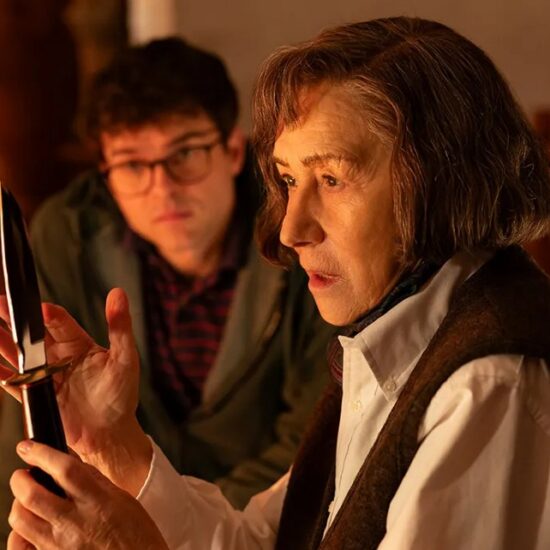
The screenplay, by Simon Rich, is pitched at a high-wire level of tech-geek patter, to the point that you may not follow every line. Yet that’s part of the film’s exhilaration — it keeps you on the edge of your brain — and it’s also what gives it the ring of authenticity. This is exactly how these dudes think, and how they talk. (Most of them are dudes, though not all.) The film opens in Toronto in 2003, where Ilya Sutskever (Yura Borisov), a 17-year-old graduate of the University of Toronto, walks into the classroom of Prof. Geoffrey Hinton (Mark Rylance), a British-Canadian computer scientist who’s been trying to work up a model of artificial intelligence. Ilya is looking for work as an assistant, and the professor, with his dandyish nerd arrogance, tells him to look at a paper he’s written and come back in a few days. Minutes later, Ilya returns, having looked deeper into the material than the professor has, and he’s scrawling an equation on the blackboard that Hinton says “took him five years to learn.”
Ilya, you see, is a stone-cold genius. He’s like the Einstein of AI, with an ability to see models of it rotating in his head. He’s also a Russian émigré who speaks in an accent as thick as borscht and gazes out at the world with a stunted glower of beetle-browed sincerity that makes it look like it’s never occurred to him in this life to tell a joke or even to laugh. This is a personality of complete tech-geek maximalism. Yet playing this driven, earnest, possibly on-the-spectrum visionary of the computer age, Yora Borisov, the bald co-star of “Anora” (he sports short dark hair here, gathered in unkempt tufts and clumps), gives what may be the performance of the year. His Ilya can seem hard to warm up to at first, but he’s an authentic human being, who we begin to form an attachment to, especially when he starts to warn about the dangers of AI. What draws us to him is that he’s the key inventor of the brave new world, and also the only one who completely gets it. Borisov shades that with grace notes of tragedy.
By 2012, Ilya and Hinton have comes up with an AI model that’s developed enough to place in an auction. Within five seconds, there’s a bid on the table for $20 million, and the two decide to sell their knowledge to Google. They will set up a lab there, working independently, and have their research funded. This works for a while, but John (Chris O’Dowd), the Google executive in charge, doesn’t really get where they’re going with AI. He’s not onboard with the vision of it. Sam Altman, a rising star of Silicon Valley, is.
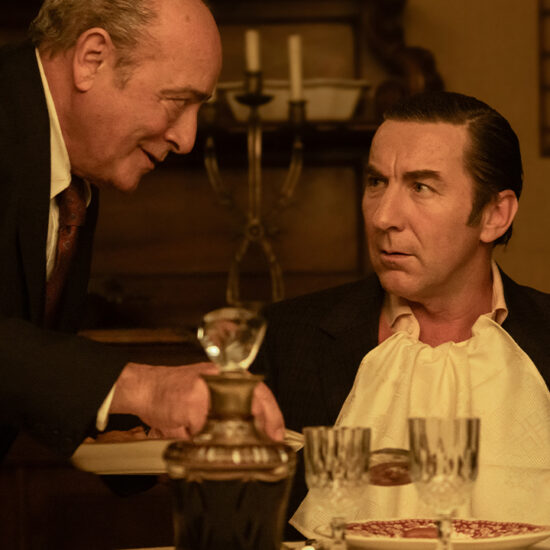
Gaudagnino’s last stab at zeitgeist topicality, “After the Hunt,” turned out to be a mixed bag, but in “Artificial” he’s at the top of his game, working with the impish human factor that was there in “Challengers,” his slyly exhilarating tennis-triangle movie. Guadagnino stages the film as an eclectic jamboree of brainstorming sessions and office showdowns and bro parties, and he gives it all a dramatic hotfoot with the scenes that include Elon Musk, played by Ike Barinholtz in an irresistible showbiz turn that lands just this side of caricature. His Elon is the god of the geeks and knows it. Dressed in black, holding his body at skewed “rock star” angles, his mouth turned down into a grimace of power, he’s the one who can make things happen. Guadagnino stages a group dinner, in which Ilya gets to know Altman and his pals (this is where it’s first revealed that Altman is gay), and Musk crashes in like the lord of the frat house. His bluster is easy to mock, but he’s quicker than anyone in the room, and he goes in with Altman on backing OpenAI.
As it turns out, Elon is too quick for his own good. He wants the AI models advanced, faster and faster, so that they can kill the competition. But with AI it’s not going to work like that. That’s why he opts out, and Altman takes over as sole CEO. There’s a way that the film catches the audience up in the booster spirit of early AI, when everyone is convinced that it’s going to be a powerful force for good. It will solve world hunger and teach the immune system how to beat cancer cells. The technology will achieve critical mass when it becomes AGI (artificial general intelligence), which means that it’s now teaching itself how to think. This first happens when AI plays — and wins — a video game with one of the OpenAI geeks, and the super-slow-motion beer-spraying party celebration that follows is bravura filmmaking, expressing how the lust for computers to take over our world has become nearly sexual. The film’s musical score, by Damon Albarn of Blur, has a haunting Bowie-like party-on-the-abyss shimmer.
At OpenAI, the bro slogan, led by Ilya, is “Feel the AGI,” which is a kind of Peter Pan mantra. It means: The technology will come to life — literally — if you believe in it. But the moment where Ilya learns that AI has become so smart that it can tell a joke, and lie…at that point, you feel the world shift. The documentary “The AI Doc: Or How I Became an Apocaloptimist” captured many of the same issues, but to see the monster actually rise up before your eyes, to the point that its creators are terrified, gives “Artificial” an ominous power.
The movie takes us deep into the tech world and its ultimate paradox: the way our tech reality, which can seem so coldly factual, is actually shaped by personality. The performances sizzle, from Cooper Hoffman’s Adam Sandler-on-Adderall turn as the OpenAI super-geek Greg Brockman to Monica Barbaro as the ambiguously tranquil Mira Murati, who becomes the company’s chief technology officer, to Rylance’s delectably refined professor to Jason Schwartzman as an ex-academic screw-loose hippie who has foreseen all the dangers of AI. The conversation he has on a San Francisco bench with Ilya is the film’s equivalent of Donald Sutherland’s great scene in “JFK,” and it leaves a chill hanging in the air.
And then there is Sam Altman. Garfield plays him as a corporate seducer, and he does it by seducing the audience, making Altman winsome in his enthusiasm, a softly charismatic player who believes in the right things. And he really does…until he doesn’t. The central conflict in “Artificial” is this: The development of technology moves so quickly that for your company to succeed, to thrive, or simply to survive, you’ve got to win. You’ve got to be first. And that puts the emphasis on speed. But Ilya, cognizant of the profound dangers of AI, says that the new technology must be developed in tandem with an appreciation for how threatening it is. The trick is that it has to be developed through interaction with humanity…because it literally evolves by doing that. So…easy does it. Test it all out.
But that doesn’t chime with the business plan. As the film goes on, Garfield’s performance grows more layered and duplicitous in a nearly subliminal way, as we start to pick up on the priorities lurking just beneath Sam’s silky manners. He wants to advance the tech — which is what tech bros are supposed to do. But AI isn’t like other tech. Throwing safety to the winds could be throwing civilization into the trash.
Is that what’s happening now? The power of “Artificial” is that it so ominously captures the ambiguous place we’re now in with AI — on the cusp of a revolution, with warnings in place, yet no one is there to regulate it. (Obviously, that should be the U.S. government, but under the current leader we barely have one.) Garfield’s Altman becomes the seducer-as-betrayer, but the film is about something much bigger than his being the “bad guy.” In “Artificial,” everyone goes along with Altman, even after he’s fired from OpenAI, because he convinces them that if they don’t go along, the only other options are worse. The film is about the victory of greed, but also about something as sinister as “Invasion of the Body Snatchers.” What’s been snatched away is our desire to guide our own destiny, and maybe even be who we are. At the end of “Artificial,” we’ve handed that away all too eagerly, ceding our power to the ghost in the machine.