
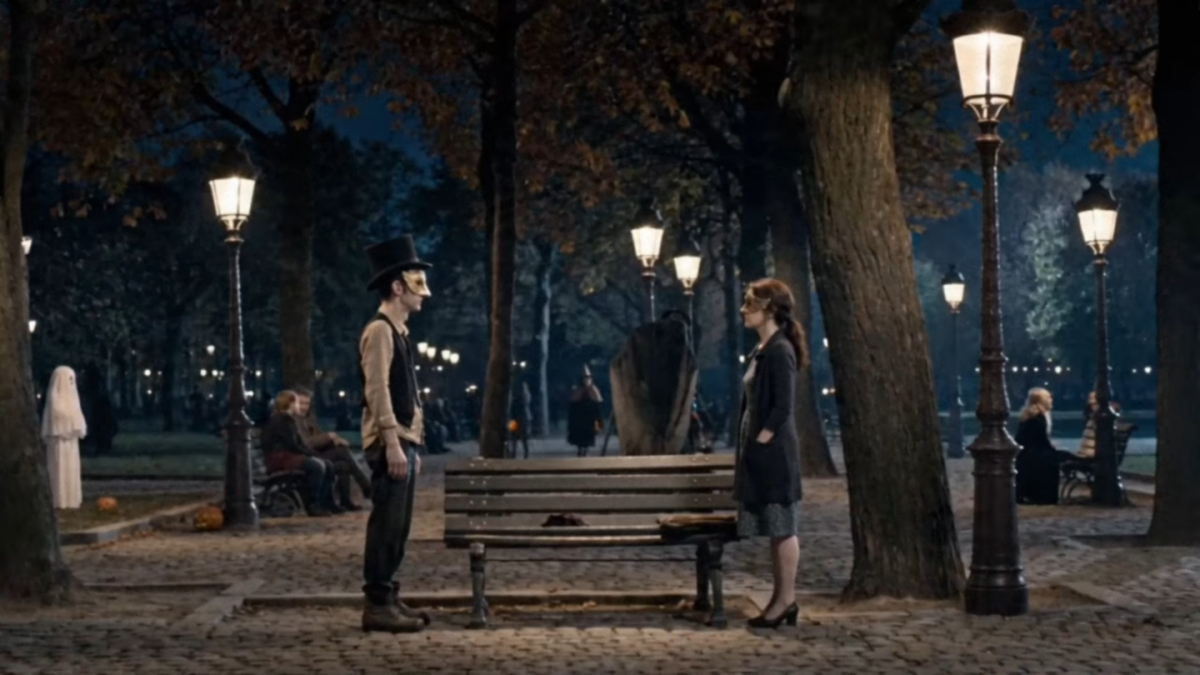
Let’s get one thing clear: all appearances to the contrary, A Face Only a Mother Could Love was not shot by Charlie Kaufman or Michel Gondry or Wes Anderson. It was not shot by any known filmmaker. In fact it was not shot at all.
The eight-minute short — in which a Parisian man with a facial disfigurement named Marcel dances hopefully in his apartment every night awaiting a non-existent companion — is in fact the brainchild of one Robert Gaudette. Emphasis on the brain. Or, more accurately, the intelligence. Of the artificial kind.
And emphasis on the one.
Gaudette used a series of AI tools — and not a single actor, producer or crew member — to tell his tender story of a man who, for all his travails, hardly wallows in his station. To the contrary: he keeps an irrepressible optimism that we could all use in these days of, well, AI film takeovers. Watching the movie and Marcel’s fragile belief in a world so callous is to feel a surge of possibility for humanity. It is also to feel a much more complicated set of emotions about our AI creative future.
Depending on your point of view, Gaudette is cinema’s great hope in this automated age — no one can look at what he created and call it anything but art. Or he poses its greatest threat. Once you can do that with AI, what point is there to a traditional film set? Or the likelihood an original director goes out and shoots original shots? Gaudette represents the brave, bold, knock-you-on-your-backside future of filmmaking, in which one person with a good idea and some free time can conjure something we used to wait years and comb festivals (or, I guess, YouTube) to find. Or, since so many vision-filled types like him lacked the resources, never found at all.
Or Gaudette represents the brave, bold, knock-you-on-your-backside future of filmmaking in a much worse way, in which time, money, actors or anything human the process might lubricate or use as lubricant has quietly slipped away. This is what happens when film becomes so radically populist literally anyone can do it without building a set, leaving the house or even picking up the phone.
Gaudette has no formal film training — he taught himself editing, sound engineering and other technical skills on the side — and has never published a story before. But he has been writing scripts, sticking them in drawers, one after the other, the number soon topping 25, 30. All to the utter indifference of a Hollywood that hadn’t even bothered to hear of him.
Robert Gaudette
Robert Gaudette
“No one was going to fund a short film made by me,” Gaudette said in a phone interview with The Hollywood Reporter from his home in Toronto on Tuesday evening, sounding a little like his lugubrious main character. “But with AI I guess they don’t have to.”
A soft-spoken man with a heavy Canadian accent, Gaudette worked in tech early in his career, tried his hand at full-time photography upon amassing a few loonies, then pivoted to nonprofits. When Midjourney and other image-generation tools came along in 2022, he began a side hustle, now his full-time job, of generating shots using AI. Say you’re an agency pitching your commercial idea to a brand and you need to show what your vision will look like. Gaudette will come in and, with almost zero production cost, whip up a vision for you to present. Need a pickup or difficult shot for your TV show and don’t have the budget? Here comes Dr. Bob again, offering the cure for a handful of Canadian TV series.
Gaudette is one of the first people who can legitimately say he is making a living exclusively doing AI video generation — to AI filmmaking in the 2020’s what Jeffree Star was to social-media influencing in the 2000’s. You can make a living doing that?
And, as of last Thursday, Gaudette has also made perhaps the most touchingly human movie ever generated by AI. Which, admittedly, is a very short list. Then again, just the fact that the words “touchingly human” and “generated by AI” can exist in the same sentence merits some kind of award.
In fact, he won an award — the $50,000 “Grand Prix” at the Runway AI Film Festival in New York last week. The annual gathering — Runway, a video-generation startup with more than $800 million in funding — rented out Alice Tully Hall for the occasion. There was a genuine frisson among the largely AI filmmaker audience when Gaudette’s film screened. Certainly there were other movies of note — a French childhood-summer movie called Costa Verde leaned in to the hallucinations to magical effect, suggesting a serious leveling up in the year since the company last held the gathering. (An L.A. installment plays Thursday.)
But Gaudette operated on another plane. When Runway co-founder Cris Valenzuela called out the winner, the crowd practically erupted, happy for their colleague in this still-small community but also, perhaps, happy for the crossing-the-chasm moment. Whatever happens from here, Gaudette has proved one thing that many in traditional entertainment said could never be proved: an LLM-generated film can make you feel. “I had hoped I could do that,” he said. “But I didn’t know if it could be done.” (You can watch the film and its poignant story — which in addition to Kaufman and Anderson may also give a little Guillermo del Toro, a function of Gaudette’s talent and/or how AI models can synthesize major directors’ work — further down below.)
Until a few months ago, Gaudette hadn’t really tried his hand at filmmaking. But he had been toying with the idea of a lonely man in Paris, and so he began writing. And now here he is, with a nascent aesthetic’s most notable work, all for two weeks of (admittedly seventeen-hour days) of working.
The Paris in his film feels stylized, idealized. There may be a good reason for that: he’s never been to Paris. Instead Gaudette relied, via the AI, on the many scraped directors who had. Perhaps just as well. Showing up to shoot in person would only have ruined the city with its realness.
Generating shots is…not easy. The model can really only handle 5-8 seconds at a time, which means you can’t do very long takes — a oner isn’t happening anytime soon. And, more important, it means you spend a lot of time scrapping what you had and starting again to make sure your new shot matches the old ones.
See, a model mostly doesn’t remember the previous shot — reports of it as an assistant director are greatly exaggerated — so you’re starting from scratch each time, spinning the roulette wheel and hoping your new generation looks like a continuation of the scene from the last one.
This is what leads so many AI filmmakers to cut their shots and scenes short; an NBA Finals director with an eye on Chalamet has fewer cutaways. But Gaudette did things the hard way, putting together scenes that can last 30 seconds or longer, which means an astonishingly high number of generations until the model gets it right. Or an astonishing number of water gallons. On the other hand, it’s not like there’s a production van rolling around polluting everything.
The entire process feels intense. Also, a crapshoot. “There is a lot of gambling, a pulling of the slot machine,” Gaudette admitted. Then again, if something isn’t working, you haven’t wasted a half-day of shooting. You just hit delete and start again. Plus, he says, “the more you do it the more you figure out the language that will help you get what you want.”
You can watch Face and hold onto thoughts that no piece of art can truly be made with such machine help. Or you can be moved, forget entirely what you’re watching is made by AI, ask yourself who these actors are and what they’ve been in before remembering they don’t exist, and only when the credits roll (/credit rolls) ask yourself all the uncomfortable moral and spiritual questions about what even is a film anymore or what the point of a film set or industry is — as you might, as I did, as a studio executive looking to save a buck definitely will.
Gaudette doesn’t hold out much hope any festival — including his native TIFF — would ever play this movie. But he has gotten wind that a festival in Rhode Island has an AI Filmmaking section, and has a bead on another that might too.
He says it would be “amazing” if a traditional Hollywood studio discovered him via this short and brought him on to a conventionally shot project or to develop Face as a feature (there’s a lot of backstory to explore). But oddly, or refreshingly, he has no specific desire to make a transition, and is content to continue making AI films. He’s already developing his next short. He thinks he can get the whole process down to ten days.