
Independent Filmlovers, Please Note: The 2026 Raindance Film Festival Starts June 17
There are film festivals that exist to validate the industry.
And there are film festivals that exist to discover the future.
Raindance Film Festival has always belonged to the second category.
From June 17–26, central London becomes a collision point for filmmakers, writers, producers, actors, cinematographers, distributors, rebels, dreamers, hustlers and accidental geniuses. Over 80 features, more than 100 shorts, immersive projects, industry talks and late-night conversations will flood the West End.
And here is the important thing:
Some festivals are museums.
Raindance is a career engine.
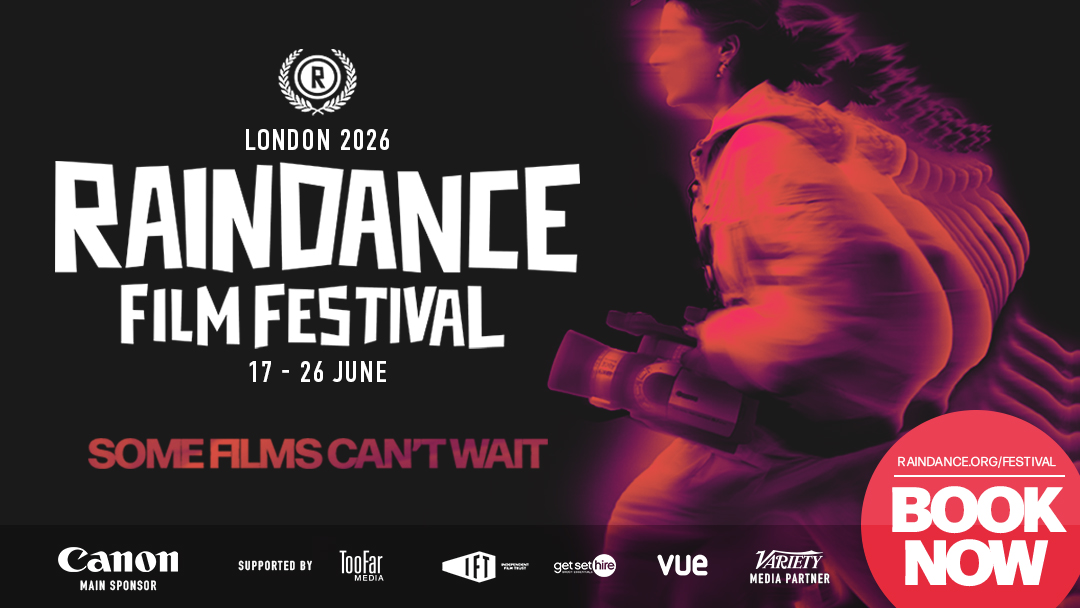
This year’s programme feels especially urgent. The official festival announcement says it plainly: “Some films can’t wait.”
That urgency runs through the entire schedule.
We screen films on:
- AI anxiety.
- War.
- Isolation.
- Identity.
- Music.
- Horror.
- Technology.
- Political fracture.
- Human resilience.
The programme, curated by Suzanne Ballantyne and Anna Taborska is not trying to soothe audiences. It is trying to wake them up. The shorts were curated by Jamie Greco, Danny Moltarsi and Anna Bernardo. Their eyeballs were bleeding from thousands of submissions from 141 countries.
If you care about independent cinema, now is the time to study the schedule:
2026 Raindance Film Festival Schedule
Here are some of the major highlights and why they matter.
1. First-Time Filmmakers Dominate the Programme
This is perhaps the single most important fact about Raindance 2026.
Forty-eight of the selected features are by first-time filmmakers. That represents more than half the feature slate.
Read that again. More than half.
In an era where the mainstream industry increasingly recycles familiar IP, sequels, remakes and algorithmically safe storytelling, Raindance is still gambling on unknown voices.
That matters.
Because every filmmaker secretly wants permission.
- Permission to start.
- Permission to fail.
- Permission to experiment.
- Permission to not sound like everybody else.
Raindance has historically been one of the few places willing to hand that permission to outsiders.
This is the festival that helped champion early work connected to filmmakers like Christopher Nolan, Edgar Wright and Ben Wheatley.
The lesson is simple:
You do not need permission from Hollywood to become a filmmaker.
You need a finished film.
A point of view.
And the courage to show it.
2. Horror Continues to Lead Independent Cinema
If you want to understand where independent cinema is heading commercially, artistically and culturally, study the horror lineup.
Seriously.
Horror is no longer the “cheap genre.” It is the laboratory of modern cinema.
Raindance has leaned into this reality hard in 2026, even introducing a new Best Horror Feature award category in honour of Roger Corman, the king of independent cinema.
Why?
Because horror is where filmmakers can still take risks.
- Horror audiences reward originality.
- Horror travels internationally.
- Horror survives low budgets.
- Horror tolerates experimentation.
- Horror allows metaphor.
- And increasingly, horror is becoming the emotional language of our time.
Climate anxiety becomes horror.
Dating becomes horror.
Technology becomes horror.
Loneliness becomes horror.
Politics becomes horror.
Even romance is starting to mutate into horror.
The festival’s horror strand reportedly spans seventeen subgenres. That alone tells you something important: horror is evolving faster than almost any other cinematic form.
Independent filmmakers should pay attention.
Not because horror is “easy.”
Because horror remains one of the last spaces where independent filmmakers can still build careers from authenticity rather than scale.
3. The Opening Night Signals Where Cinema Is Going
The festival opens with April X, a near-future thriller by debut filmmaker Michel K. Parandi.
Again, notice the pattern.
- Near-future.
- Independent.
- Debut filmmaker.
The mainstream industry often reacts to cultural shifts after they happen.
Independent cinema senses them while they are still forming.
Near-future storytelling is becoming increasingly powerful because audiences no longer trust stability. We live inside permanent transition:
- AI disruption.
- Political volatility.
- Economic uncertainty.
- Identity fragmentation.
- Information overload
Cinema that explores “what happens next?” suddenly feels more emotionally truthful than nostalgia.
And then there is another fascinating opening-night detail: the inclusion of a Gorillaz animated short.
That is not accidental programming.
It signals something much larger happening across the industry:
The collapse of boundaries between music culture, gaming culture, animation, immersive storytelling and cinema itself.
Tomorrow’s filmmakers are not just competing with films.
They are competing with experiences.
4. Documentary Filmmaking Has Become a Frontline Artform
One of the most striking things in this year’s programme announcement is the range of urgent global subjects embedded throughout the slate:
- Ukraine.
- AI.
- Fracking.
- Deforestation.
- Refugees.
- Bride slavery.
This is not coincidence.
Documentary cinema has become one of the last forms of public resistance against distraction culture.
In a world flooded with content, documentaries still have the power to stop people and force confrontation.
But modern documentaries are changing too.
Audiences no longer want lectures.
They want immersion. Emotion. Character. Narrative propulsion.
The most successful documentaries now operate with the emotional sophistication of narrative features.
And increasingly, they are becoming one of the most effective launchpads for new filmmaking careers because audiences crave truth.
Not manufactured truth.
Observed truth.
The kind that only independent filmmakers are still brave enough to chase.
5. Raindance Immersive Is Quietly Predicting the Future
Most filmmakers still underestimate immersive storytelling.
That is a mistake.
The 11th Raindance Immersive strand includes 27 XR projects, combining physical installations with online VRChat experiences.
Many traditional filmmakers dismiss immersive work because it does not yet fit classical cinematic grammar.
But that is precisely why it matters.
Every major storytelling revolution initially looks awkward.
- Sound looked awkward.
- Colour looked awkward.
- Digital looked awkward.
- Streaming looked awkward.
- Vertical video looked awkward.
Immersive storytelling is not replacing cinema.
But it is forcing filmmakers to rethink presence, participation and audience psychology.
The younger generation already understands this intuitively. They move fluidly between games, social media, live-streaming, VR spaces and narrative content.
To them, storytelling is no longer confined to a rectangle.
Raindance recognising this matters enormously.
Because festivals that survive the 2030s will not merely screen films.
They will curate experiences.
6. The Industry Programme May Be More Valuable Than The Films
This is the secret many first-time attendees miss.
The screenings matter.
But the conversations matter more.
The Canon Lounge beneath the BAFTA building is likely to become one of the key networking spaces during the festival.
And networking is not about “collecting contacts.”
It is about finding collaborators.
- Writers meet directors.
- Directors meet producers.
- Actors meet cinematographers.
- Composers meet editors.
- Future companies accidentally form over coffee.
Independent filmmaking has always been tribal.
The people you meet at festivals often become your professional ecosystem for the next decade. And in today’s fragmented industry, ecosystems matter more than gatekeepers.
The other major highlight is the cinematography masterclass presented by Canon Europe.
This matters because cinematography itself is changing rapidly.
The democratisation of camera technology means technical quality is no longer enough.
- Taste matters more.
- Visual identity matters more.
- Restraint matters more.
Everybody has access to decent cameras now.
Very few people have developed a visual philosophy.
7. Raindance Remains a Festival of Discovery
This might be the most important point of all.
Raindance is still fundamentally about discovery.
- Discovery of filmmakers.
- Discovery of styles.
- Discovery of forms.
- Discovery of yourself.
And discovery matters because modern culture increasingly pushes filmmakers toward imitation.
- Copy what worked.
- Copy the algorithm.
- Copy the trend.
- Copy the platform.
But cinema only evolves when someone refuses to copy.
That spirit still runs through Raindance.
The schedule is filled with films that probably should not exist according to conventional industry logic.
That is exactly why they need to exist.
Independent cinema has always depended on unreasonable people.
People willing to make films before permission arrives.
- People willing to look foolish.
- People willing to fail publicly.
- People willing to gamble years of their lives on a story.
Raindance continues to provide a home for those people.
And that may be more important now than ever before.
Why You Should Go
If you are an independent filmmaker, here is the truth:
You do not attend festivals merely to watch films.
You attend festivals to recalibrate belief.
- To remember that cinema is still alive.
- To remember that audiences still care.
- To remember that other filmmakers are fighting the same battles you are.
The 34th edition of 2026 Raindance Film Festival runs June 17–26 in London’s West End, centred around Vue Piccadilly and the Canon Lounge at One Ninetyfour.
Over 80 features.
112 shorts.
Immersive experiences.
Industry events.
Emerging filmmakers from around the world.
Independent cinema is not dying.
It is mutating.
And if you want to see where it is heading next, study this schedule carefully:
Explore the 2026 Raindance Film Festival Schedule
Then buy a ticket.
Then show up.
Because careers do not happen in isolation.
They happen in rooms full of people who still believe cinema matters.
Did You Know?
Photo Credit: Bertie Watson
I founded Raindance Film Festival in 1993 because the British film industry was closed, polite, and congratulating itself while shutting new filmmakers out.
I co-founded the British Independent Film Awards in 1998 because British indie film deserved more than a shrug, a pat on the head, and a Tuesday night screening.
Raindance didn’t start as a brand.It started as a rebellion — film training without gatekeepers, a festival without permission, and a community built by filmmakers who weren’t waiting to be invited in.
Later, we took it global — Toronto, Vancouver, New York, LA, Berlin, Brussels — because independent film doesn’t belong to one city, one class, or one accent.
I’ve produced 700+ short films and seven features, including Deadly Virtues (2014) and ALICE, which won the SXSW Grand Jury Prize (2019) not because someone “discovered” us, but because the work earned its place.
I’ve written three books used by filmmakers worldwide because too many courses taught compliance instead of survival.
In 2009, I was awarded a PhD for services to film education, ironic, given that most of my career has been about tearing down the rules that education insisted you follow.
I don’t believe in waiting for permission.I believe in making work, building systems, and forcing the industry to catch up.
Specialties: Independent Film (the real kind) · Producing · Writing · Film Education · Festivals · Breaking Broken Systems
Check out my new Substack for in depth Free Articles:
Related