
It started, as many independent films do, with a room full of ideas and no guarantees.
The BFI-supported pitching session wasn’t just about finding a strong concept — it was about finding people. People willing to bet on themselves. Among dozens of hopefuls, what emerged wasn’t just a project, but a team: directors, writers, editors — raw, instinctive, digital-native storytellers who didn’t yet have permission from the industry, but didn’t need it.
That’s where my journey with LifeHack, and as a producer, really took shape.
Not in a boardroom with a greenlight, but in a room where talent had to prove itself first.
Working alongside Timur Bekmambetov, whose influence has reshaped screen-based storytelling, my role was clear: find the voices, build the team, and create a pathway that didn’t rely on traditional gatekeeping or financing structures. The result was LifeHack — a film born not from a system, but from a process of discovery.
The model sounds simple, but it isn’t:
Find the talent.
Build the proof.
Convince someone to take the risk.
Then do it again.
From Idea to Proof
After the initial pitch, we moved quickly — not towards a finished film, but towards a proof of concept.
This is where producing becomes something else entirely. It’s not logistics or oversight — it’s belief. Sustained belief, often without validation. The team built the proof piece by piece and quickly realised that screenlife isn’t a shortcut — it’s a complex, highly technical form of storytelling.
What we were building wasn’t just a film.
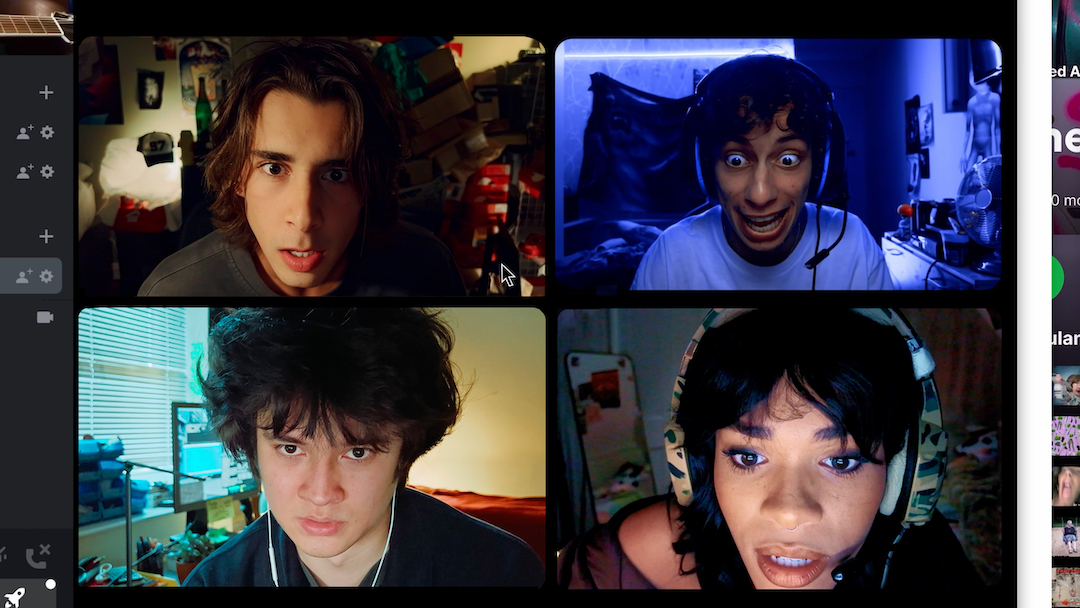
It was the development of a film language rooted in first-person POV.
When that proof landed, something shifted.
Timur saw it — not politely or cautiously, but with the instinctive recognition that experienced producers have when something genuinely works. That moment — when someone says “yes” — is everything.
But it’s also just the beginning.
The Startup Model of Filmmaking
Traditional film financing didn’t apply here. There was no established director, no commercial track record, no safety net.
So I structured the project differently — more like a startup than a film.
Each stage had to justify the next:
• Proof of concept
• Script
• Previsualisation
• Production
At every stage, the challenge was the same: convincing someone to invest and take the next step.
The previsualisation became the turning point. We built the entire film before we shot it — testing it, shaping it, proving not just the idea, but the execution. How it would feel. How it would move. How it would breathe.
That was the moment the film became inevitable.
And still — it was far from easy.
The Real Work
There’s a misconception in filmmaking that once financing is in place, the hardest part is over.
It isn’t.
That’s when the real work begins.
The shoot itself lasted just two weeks — fast, intense, stripped back to its essentials. But the real film was built in post over more than a year.
This is where producing becomes most visible. Not just managing timelines, but holding everything together — creatively, emotionally, practically — through a process that is, by its nature, exhausting.
Independent filmmaking is not a straight line.
It’s a constant negotiation:
Between ambition and limitation
Between vision and reality
Between what you want to make
and what you can afford to make
More often than not, things only come together at the last possible moment.
The 11th Hour
This is the truth people rarely talk about.
In indie film, the pieces rarely fall into place early. They fall into place at the 11th hour.
The composer discovered by chance in a pub.
Casting shaped through instinct rather than process.
Creative solutions driven by limitation rather than design.
These aren’t anomalies.
They are the process.
Producing at this level isn’t about controlling chaos — it’s about working inside it. Keeping the film moving forward without a clear path. Keeping people motivated without certainty. And holding belief in the project long before anyone else sees it.
From Film to Market
Making the film is only half the battle.
Once LifeHack was complete, it entered a different world — the marketplace. And the rules changed again.
No matter how strong the film is,
no matter how innovative the format,
no matter how relevant the story —
it comes down to one thing:
Can someone sell it?
The SXSW premiere marked a turning point. It validated the film creatively and positioned it on an international stage. But festivals are not the endgame — they are the beginning of the next phase: sales, distribution, positioning.
At this stage, the role of the producer shifts again — from building the film to shaping how it is seen.
A film doesn’t exist in isolation.
It exists in how it is understood.
The Final Convincing
Independent film is built on belief.
At every stage, someone has to be convinced:
That the idea works
That the team can deliver
That the film will find its audience
My journey with LifeHack has been defined by that process.
Finding the team.
Developing the talent.
Building the film.
And then — convincing the world that it matters.
Even with a strong creative team, even with a clear strategy, it ultimately comes down to one final stage: the sale.
A sales agent who can walk into a room and secure not just theatrical distribution, but SVOD platforms, brand partnerships, and merchandising — building a multi-platform ecosystem that proves the film’s commercial and cultural value.
Understanding that landscape — what the film is worth, where it can live, and how it can travel — became a critical part of my learning as a producer.
Because it’s not just about getting the film made.
It’s about how you protect it.
Careful negotiation.
Knowing which rights to retain.
Knowing where to push, and where to hold.
Those decisions shape the life of the film far beyond production.
That shift — from making the film to structuring its future — is what defines me as a breakthrough producer.
Breakthrough — and Beyond
My approach — talent-led, development-driven, rooted in real opportunity rather than access — reflects a shift in the industry. Away from traditional pathways and hierarchies, and towards discovery, experimentation, and new voices.
LifeHack isn’t just a film.
It’s proof that there is another way.
One where you don’t wait for permission.
You build the opportunity.
You find the people.
You make the film.
And then — when everything is on the line — you bring others into it.
The film exists.
The audience exists.
What remains is belief.
That’s the hustle.
Not chaos. Not chance — but a producer’s discipline. The ability to align people around something not yet fully proven. To bring others in, to commit their time, energy, and money — knowing there are no guarantees until the film is sold and reaches its audience.
Understanding that — and knowing how to navigate it — is the real work.
Because in independent film, the job doesn’t end when the film is made.
It ends when it lands.
And getting it there — that’s the hustle.
Get your tickets to the 34th Raindance Film Festival LifeHack screening here.
BIFA-nominated breakthrough producer Joann Kushner is an award-winning filmmaker working at the forefront of Screenlife and innovative digital storytelling. She was nominated for the British Independent Film Awards (BIFA) Breakthrough Producer award and for the LCR Awards for Excellence in TV and Film, alongside winning a BIMA Award for innovation in new technology for film.
A champion of emerging talent, she has built a strong track record developing and producing projects with first-time writers and directors. Her recent feature LifeHack, a critically acclaimed Screenlife heist thriller, successfully launched new creative voices and premiered at South by Southwest (SXSW), earning recognition for its bold use of digital-native filmmaking.
She is currently developing her second feature in collaboration with Image Nation Abu Dhabi and Film Clinic Cairo. The project, working titled You Should Talk to Someone, was discovered through a Middle East accelerator programme focused on identifying and supporting emerging regional filmmaking talent.
She is also developing a slate of projects including TROLLS, a new Screenlife tech-thriller exploring cyber activism, online espionage, and digital conspiracy culture.
Related