
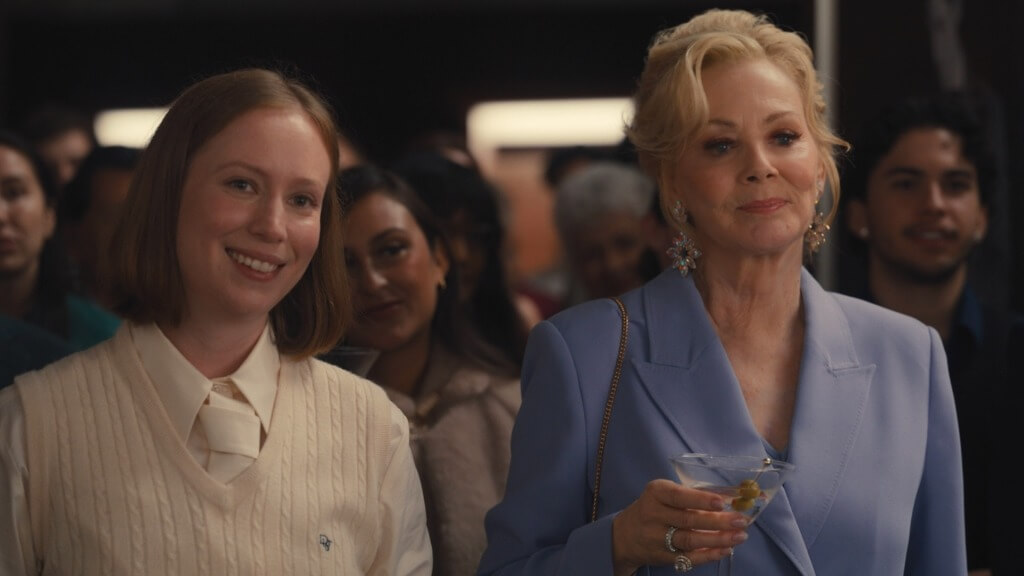
Hacks doesn’t owe us a mission statement. Even as the series’ commentary on Hollywood has grown more pointed and its real-life parallels more obtrusive, it has never been under any real obligation to spell out themes or adhere to them. More often than not, meaning is ascribed to a text by its readers or viewers. And for many, the pleasures of Hacks have come from simply watching its two complicated leads find a way to bring out the best (and sometimes the worst) in each other.
And yet, especially for those of us who tend to overthink things, every season of Hacks has been about something: navigating the industry as a woman and splitting your head open trying to break the glass ceiling; weighing the demands of commerce against the needs of art; and even illustrating how anger can become a terrible motivator if you cling to it too long. It has also been undeniably funny, getting laughs from everything from Deborah and Ava’s particular brands of self-righteousness to writers’ lunch orders to a mismatched (but winning) pair of managers. What will viewers remember most: the substance or the humor?
A version of that question has been hanging over this season, as Deborah’s challenged the revisionist history that threatens to take the place of her lived experience. What will she be remembered for? More importantly, what does she want to be remembered for? In the season-five premiere, she decided she needed a legacy-defining win to combat the Bob Lipka spin machine, then determined that selling out a show at Madison Square Garden would be her crowning achievement. This, Deborah argued, was how she’d take back control of her story, though she didn’t seem to note that it would still mean measuring herself by the metrics of others’ success. That is, until “Who’s Making Dinner?” (B+), the first episode in this week’s paired offering. The title of the episode is also the title of the CBS sitcom that first made Deborah a star, then a betrayed wife, then a joke, and finally the formidable multihyphenate who can’t speak to any of her accomplishments at the Paley Center exhibition of the show she helped create, thanks to the restraining order she received at the start of the season.
Up until her breakthrough in a Los Angeles jail, Deborah has trouble expressing herself and not just because of the gag order. The new material she tests on her staff in the opening just comes across as hectoring, not cutting, and she’s started punctuating all of her punchlines with “y’all.” Ava urges her boss to lead with observations of what’s actually been funny about the last few years, but Deborah argues that “If comedy says something, it’s supposed to make you uncomfortable. I mean, you’re the one who always says it doesn’t have to be a laugh a minute.” Deborah’s undeterred by the fact her act is “Smith College commencement address at the moment”—she’s found a bully pulpit (or “persecution pyramid”), and she’s going to use it.
Traveling to L.A. for the exhibition opening does little to improve Deborah’s mood or comedy at first. The photo and costume displays remind her of what she’s lost—or, more to the point, what was taken from her—and she’s once again being called “crazy” (sorry, “having mental issues”). When she learns that a previously unaired interview with Frank will be shown—”He’s upstaging me from the grave!”—Deborah loses her already tenuous grip. Before she storms the stage to take some potshots at her dead ex, she tries to justify it to Jimmy: “I’m not just doing this for me; I’m doing this for all women who have been silenced.” (Between his softly bewildered “How?” at this and his physical comedy with Anna Konkle, Paul W. Downs provides several of this episode’s laugh-out-loud moments.) What comes next is flop sweat personified: Calling Joan Of Arc her “sister in the struggle” and lapsing into “y’all”s again is bad enough, then she tells the crowd that Frank’s family “had slaves. Nasty stuff.” She fairly slinks away, but not before watching the unearthed interview with Frank (played in his later years by Peter Strauss and by George Kareman in the flashbacks/sitcom footage). Asked how he knew Who’s Making Dinner? was funny, Frank doesn’t hesitate in telling the off-camera interviewer, “Because of Deborah. Deborah was the funny one. She was always the funniest person in any room.”
It’s not enough to undo taking sole credit for the show, or cheating with her sister, or any of the other injuries that followed. But Frank’s admission shakes Deborah to her core. “It’s been 50 fucking years,” she tells Ava, who cannot resist noting that Deborah “bombed superhard.” (She kids because she cares.) “Why do I still need to hear that? Why should I care about what some kid who I met when I was 18 years old thinks about me? It’s pathetic,” Deborah sighs, more unmoored than ever. She doesn’t have a bead on her material for the Garden show, the one she says has to be “record-breaking,” and, in this moment, she’s also without the anger that’s undergirded her career in the decades since her fall (more like shove) from grace. And even though what she just did onstage hardly constitutes “comedy,” as Ava points out, Deborah is arrested for violating the restraining order as she leaves the event.