
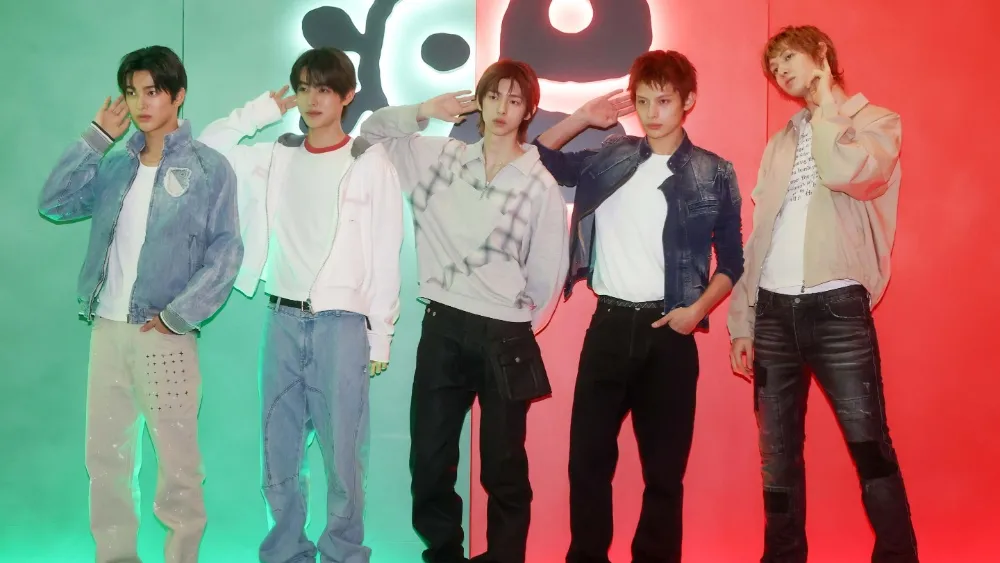
The bingo card asks you to pick a side: McDonald’s fries or pineapple pizza? The answer, apparently, says something about who you are. It’s the kind of playful, low-stakes self-interrogation that K-pop group Cortis have built their brand around – and inside a neon-drenched hideout in the heart of Seoul, 30 fans got to work it out alongside the group themselves.
The space is split between two worlds. The Red side hits you first – deep crimson walls pulsing under neon light, electric and visceral. Cross into the Green, and the temperature drops: teal-washed surfaces, an arched wall layered with photos and mementos, neon accents that feel more intimate, more personal. It’s the visual language of “Redred,” the lead single off Cortis’ second EP “Greengreen,” made physical and walkable.
On April 28, Airbnb threw open the doors of the Airbnb & Cortis Seoul Hideout for an exclusive two-hour experience. Guests moved through the space chasing UV-lit hidden clues, customizing keycards, and raiding lockers filled with symbolic objects before marking their preferences on the bingo card. It concluded with a game of Jenga – played, to the crowd’s delight, with all five members of the group sitting across the table.
“There’s no distance in the way they interact with fans,” Rosa, a 22-year-old Indonesian student who has followed the group since before their debut, told Variety. “It was like playing with friends.”
For Cathy, a 27-year-old Taiwanese food industry worker who flew in for her birthday, it was her first offline fan event. “I was always into girl groups, but since I discovered Cortis, I can’t go back anymore,” she said. “They have so much energy, they’re a breath of fresh air.”
The group – consisting of Martin, James, Juhoon, Seonghyeon, and Keonho, who debuted under Hybe’s BigHit Music label in August 2025 – have had a vertiginous rise. Their debut EP landed at No. 15 on the Billboard 200, and earlier this year they headlined the opening night of the NBA Crossover Concert Series during NBA All-Star 2026, becoming the first K-pop act to lead the event.
“It feels special to invite our fans, Coers, into our Seoul hideout,” Cortis said. “‘Redred’ is all about discovering ourselves – what we lean into, what we push back against. Through that, we’ve developed a clearer sense of musical taste. We’re excited for fans to discover their own color and share that moment with us in person.”
For Airbnb, the partnership is the latest move in a strategy that has been quietly building for years. The company first tested the K-culture playbook in 2022, offering two guests a night in the property where BTS filmed their reality show “In the Soop.” A first-ever overnight stay at Seoul’s Dongdaemun Design Plaza followed in 2023, in partnership with Enhypen, and in 2025 they ran a series of experiences across Korea, Japan, and Los Angeles with Seventeen.
The commercial logic is straightforward. According to a consumer survey commissioned by Airbnb across the APAC region and the U.S., 94% of visitors and prospective travelers to Korea say K-culture influenced their decision to go. Food leads the way as a motivator at 59%, but K-pop registers at 26% overall – climbing to 36% among Gen Z and 40% in the Chinese market.
“K-pop fans stay longer, spend $435 more than average, and travel in groups,” Lyla Seo, Airbnb’s Korea country manager, told Variety. The company is also candid about a secondary ambition: using high-profile experiences to stimulate the supply side. “We hope that when people see the demand, they’ll want to provide the supply,” said Sharon Chan, Airbnb’s head of APAC communications.
That supply has been squeezed. New regulations in Korea took down a significant portion of Airbnb’s Seoul listings last year, and Seo is blunt about the strain that surges in demand can place on an already-constrained inventory. “During last month’s BTS return concert, occupancy was amazing throughout the weekend. Maybe too amazing, because all our bookings were occupied.”
The broader pop-up – free to attend, no Cortis appearance included – opens to more than 1,000 guests from May 1-7. As Korea’s government pushes toward a target of 30 million inbound travelers by 2028, partnerships like this one are increasingly part of the conversation about how to shape policy and regulation around a new kind of cultural tourism – one where the playlist is also the itinerary.