
Lee Cronin’s The Mummy is a title that arrives with decades of cinematic dust clinging to it. In the hands of writer-director Lee Cronin, it quickly becomes something stickier, more tactile, less concerned with legacy than with the immediate unpleasantness of bodies and grief going wrong in close quarters.
Cronin’s approach is refreshing. Rather than a bandaged revenant stalking tombs, we deal with a malign presence that inhabits, distorts, and weaponizes the human form. It’s a neat inversion of the myth. Initially, there’s a sense of whodunnit and bold reinvention, which gradually gives way to something more diffuse, giving the impression that the film is feeling its way forward scene by scene rather than building toward a clear shape.
The missing persons narrative runs from Aswan, Egypt, to an isolated, dust-blown stretch of Albuquerque, a setting that mirrors rather than escapes the harshness of what came before. And the emotional engine is strong. Charlie Cannon (Jack Reynor) and his wife, Larissa (Laia Costa), ground the story as parents confronted with the return of a daughter they have already mourned. Cronin lingers on that idea of reunion curdling into dread, and those passages have a rawness that plays on instinctive parental angst. The idea that you might get your child back and immediately wish, or half-wish, that you hadn’t is far from a comforting thought – and the film doesn’t try to soften it.
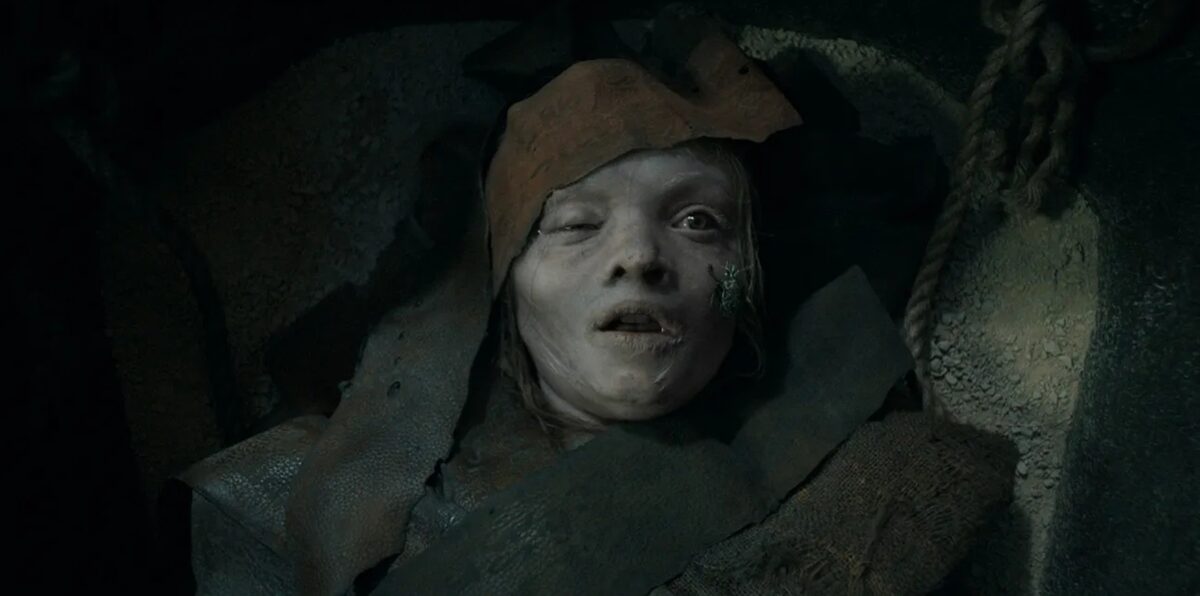
After being abducted and subjected to years of confinement, their daughter Katie (Natalie Grace) re-enters the frame, and everything tilts. Her performance is physically committed to the point of near-contortionist spectacle. Echoes of The Exorcist are unmistakable and visually striking, no question, though there are moments when the sheer extremity of it risks tipping from unsettling into gratuitous.
“After being abducted and subjected to years of confinement, their daughter Katie re-enters the frame…”
Cronin’s horror sensibility, honed on Evil Dead Rise, leans heavily into the grotesque. When Lee Cronin’s The Mummy goes for the jugular, it does so with fervour. At times, that yields genuinely queasy set-pieces that provoke involuntary recoils. At others, it feels like escalation for its own sake. The tonal interplay between grief-driven horror and macabre showmanship never fully settles. This leads to a restlessness that threatens to undermine the emotional stakes the film works hard to establish.
Then there’s the two-plus-hour duration. Though the central idea is potent, it doesn’t quite sustain the repeated cycles of revelation and shock that the running time demands. Here, the rhythm of build and release, which works well in the shorter term, somewhat blunts the impact of what should be its most disturbing turns.
But it’s unfair to dismiss what Cronin achieves here. Undeniably, it’s compulsive viewing, there are images that linger, performances that hold the centre – such as May Calamawy’s irrepressible Detective Dalia Zaki – and a willingness to push a familiar property into more abrasive territory. I found myself wavering between admiration and fatigue, sometimes within the same scene, which may not be the reaction the film intends, but it is, at least, a response. And it’s a hard film to grade. Fans of modern horror might applaud the departure from tired traditions, whereas purists might see the shift as broaching on sacrilegious.
Lee Cronin’s The Mummy may not fully cohere, but it certainly doesn’t play it safe. The extent to which you enjoy the film will depend on your tolerance for excess.