
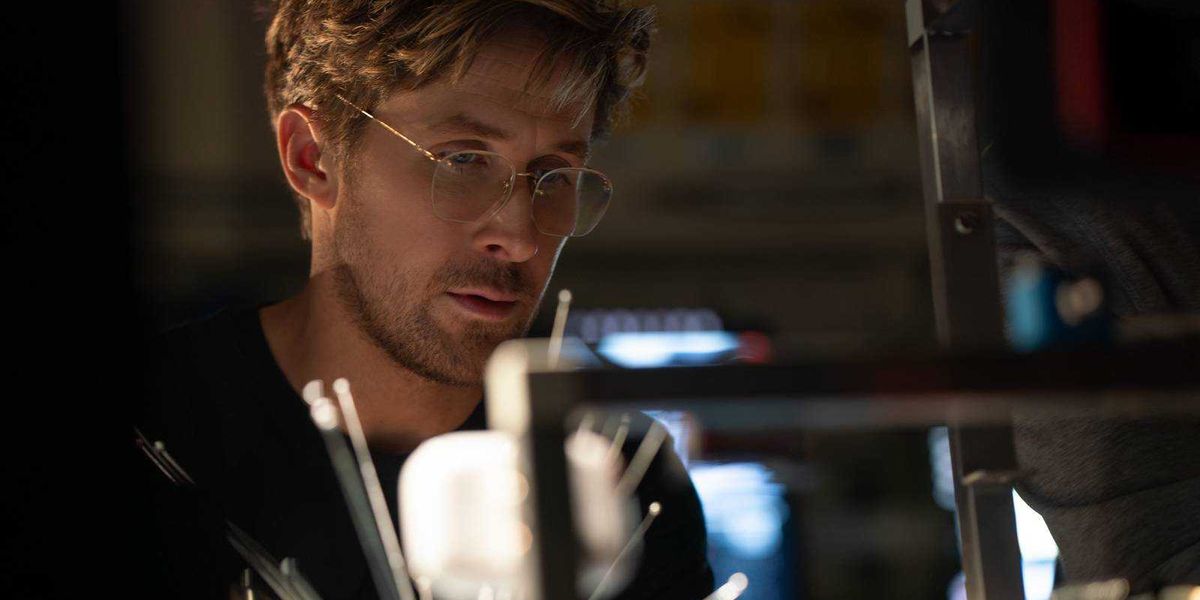
If I’m anything, I’m a huge nerd, and I love when there’s a confluence of interests like what I’ve had with Project Hail Mary, which features space, Ryan Gosling, science, creative cinematography, emotional sci-fi storytelling, and music. It’s an incredibly thoughtful film on so many levels.
Which is why I mention music. It’s been a hot minute since I’ve picked up my clarinet, but I still maintain a healthy curiosity about music theory and how music is used in film.
With a trend toward minimalism in scores over the past few years, we haven’t had the big, sweeping, cinematic soundtracks that we used to, which is why Project Hail Mary has been such a breath of fresh air. The score is playful and does not try to blend into the background at all.
And it’s incredibly smart.
In case you haven’t noticed, composer Daniel Pemberton even uses a descending motif derived from an old musical text known as the “Dies Irae.”
You’ve heard it before. Many times.
– YouTube www.youtube.com
Daniel Pemberton and Project Hail Mary
Pemberton’s score for Project Hail Mary is built around a specific philosophy, which is another reason why it sounds so different from every other movie out right now.
As documented in Mutant’s liner notes for the complete soundtrack (which I already definitely pre-ordered), directors Phil Lord and Christopher Miller described what they wanted with the phrase “hopecore,” and Pemberton built toward an organic, human-centered sound.
He used wood, metal, glass, water, and the human body itself to keep the score tactile and emotionally grounded. He worked with two London choirs and the Wells Cathedral school children’s choir for human voices.
As Pemberton told IndieWire, the unifying idea of the score was to subconsciously connect the audience to humanity because Grace represents humanity’s last chance.
Pemberton used the Dies Irae throughout the soundtrack but prominently in “Time Go Fishing,” embedded above.
In this part of the film, Grace and Rocky embark on a mission to collect Taumoeba from Adrian’s atmosphere, hoping it will save both their suns. It’s extremely dangerous, involving a low orbit and a spacewalk.
Jemma J. Jeffery has a great video on the use of the theme in this score. She talks about how it’s used to underscore the life-and-death stakes for its characters, as well as how the theme is iterated into more hopeful tones to fit the movie.
Check that out here!
For further reading, learn how to translate story into sound for more on how composers approach building emotional language.
What Is the “Dies Irae”?
According to the Chicago Youth Symphony Orchestras, the Latin phrase translates as “day of wrath,” and the text is attributed to a Franciscan monk from the early 13th century. It was written as a sequence for the Catholic Requiem Mass (a funeral rite) describing the Last Judgment, when the dead rise to face God.
As Berklee College of Music professor Alex Ludwig explains in Vox’s breakdown of the motif, the melody is built on four descending notes in a minor mode, and our ears are trained to read descending minor lines as sad, dark, and threatening.
The melody appears in major settings by Mozart, Verdi, Berlioz, Britten, and Stravinsky. It is still performed today in churches where the Tridentine Latin liturgy is celebrated.
So when you hear it in a movie theater, you are hearing something that has been sung at funerals for eight centuries.
– YouTube youtu.be
From Church to Concert Hall
But film composers didn’t invent this trick. According to Open Culture, Hector Berlioz lifted the theme in his 1830 Symphonie fantastique to tell a story of obsessive love, murder, and a nightmare witch’s sabbath, repurposing a Catholic funeral chant as a Satanic anthem.
Franz Liszt followed with Totentanz (Dance of Death), Camille Saint-Saëns embedded it in Danse Macabre, and Modest Mussorgsky used it in Songs and Dances of Death.
By the time cinema arrived, the greatest composers had already spent a century deploying it as shorthand for doom and death.
As musicologist Karen Cook writes at Sounding Out!, because early silent film musicians routinely borrowed from composed works, the chant moved quickly into cinema, where each new use reinforced its symbolic weight all over again.
The Motif Enters Cinema
Its film history stretches back to 1927, when Gottfried Huppertz scored Fritz Lang’s Metropolis with it (per Open Culture).
From there, it wound its way into Citizen Kane, Psycho, and The Shining (per The Hildegard Collective).
John Williams is also a fan. It was prominently used in A New Hope, when Luke comes home to find the bodies of his aunt and uncle on Tatooine. Just listen for it here.
– YouTube www.youtube.com
Williams also used it across Jaws, Jurassic Park, Harry Potter, Close Encounters of the Third Kind, and other Star Wars films.
Howard Shore wove it into the Lord of the Rings trilogy as the Nazgûl leitmotif. It also turns up in It’s a Wonderful Life, Home Alone, The Lion King, and Frozen II.
In Project Hail Mary, Pemberton slightly modifies the Dies Irae so it sounds more hopeful, with a driving beat, despite its traditional ties to death. It remains suspenseful but takes on an almost whimsical mood.
You might also notice that in “Time Go Fishing,” the notes don’t sound like traditional instruments—they sound like a mix of voices and a synthy organ, which mimics the sounds humans and Eridians make. You could interpret that as the song pointing to the moment being a “day of wrath” for both species, their last chance at survival.
As I said, this score is smart.
For more on how composers use recurring musical themes to build meaning, check out how music can add meaning to your film and five ways you can use film scores.
Why Filmmakers Should Care
Understanding the Dies Irae is understanding how cultural memory works in cinema. As Cook writes, every time a composer uses it, they reinforce its meaning for the next composer, so it becomes a self-perpetuating cycle of emotional association now spanning nearly a century of film history.
For filmmakers supervising or collaborating on a score, the motifs you reach for carry accumulated weight, whether you intend them to or not.
Pemberton understood that and made deliberate choices throughout. For instance, he used an electric guitar just once during the film.
As he told IndieWire, “There’s a lot of subconscious sort of writing and ideas that go into this process to make it effective. That’s the only time you really hear a rock guitar. Suddenly, we have [this instrument] which is connected to Earth more, but we haven’t had anywhere in the film because I’m trying to save it for that moment.”
This was a single late scene reconnecting Grace to Earth, so that instrument’s earthbound associations would land with full force exactly once.
Knowing which traditions you’re invoking gives you creative control over what the audience feels and when.
The Dies Irae has been in continuous use for 800 years because it does the thing it means to do very efficiently. It tells audiences that death is near. Pemberton used it to emphasize the moment in a story when Grace’s mission was most tenuous, which means on some level, every time those notes swelled, your brain was registering both the stakes and the hope underneath them.
Every musical choice carries a history. Composers who understand that history will be well on their way to telling a better story.