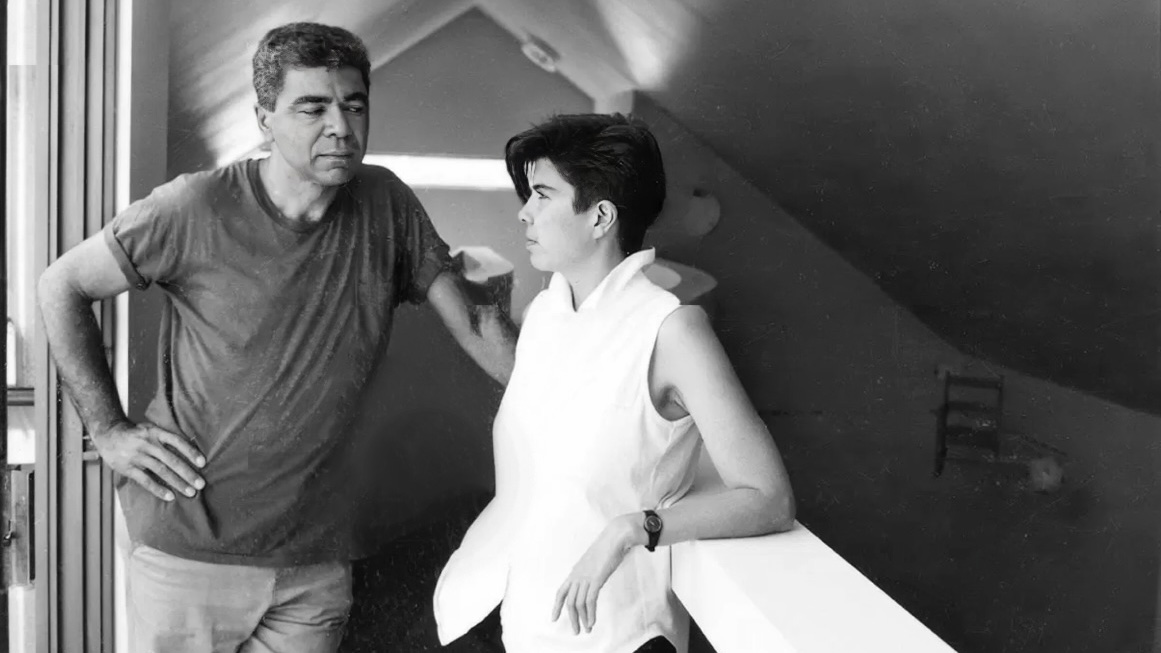
Liz Diller and Ric Scofidio began as radical conceptual artists and became two of the most influential and powerful architects of their generation, reshaping not just buildings but the way cities think about democracy, culture, and public life.
Coming of age in the 1970s New York art scene, Liz and Ric created art installations and theater pieces, not buildings: work that interrogated the hidden politics of social norms and everyday spaces. The first architects to win the MacArthur Fellowship (1999), they bridged the gap between the temporal, fluid nature of art and the fixed nature of buildings, creating cultural destinations including the Blur Building at the 2002 Swiss Expo, Manhattan’s High Line, the Institute for Contemporary Art in Boston, the Tianjin Juilliard School, and The Broad in Los Angeles.
This timeline takes a closer look at Liz Diller and Ric Scofidio’s life and the major milestones in their careers.
Subscribe to our Newsletter

RIC SCOFIDIO’S STORY
Ricardo Scofidio is born in New York City to Earle and June (Matthews) Scofidio. His father was a jazz musician — alto saxophone and clarinet — and of mixed-race heritage; his mother was of Black heritage. He has one brother, Basilio.
April 16, 1935
Ric is a student at Cooper Union School of Architecture.
1952–55
Ric marries Allana Deserio. They have four children together: Ian, Gino, Marco, and Dana.
1955
Ric receives his Bachelor of Arts from Columbia University.
1960
Ric begins practicing at New York architecture firms.
1960–79

LIZ DILLER’S STORY
Elizabeth Diller is born in Łódź, Poland, to secular Jewish parents. Diller’s mother escaped Nazi-occupied Poland on forged papers and hid in Vienna working as a welder, then as a nanny. She returned after the war to find no family, no photographs, no possessions. Liz and her brother George were given Christian names in postwar Poland to conceal their Jewish identity.
June 17, 1954

Liz’s family emigrates to the United States.
1959
Liz attends the High School of Music & Art in New York. She skips school for the Duchamp galleries at MoMA and joins protests.
1968–71
Liz enters Cooper Union as an art student and is drawn to the architecture school under Dean John Hejduk.
c. 1971
Liz and Ric meet in a Cooper Union elevator. Liz is dating Dan Kowler, a student in Ric’s second-year class. Ric is 19 years her senior and married.
Early 1970s
Liz is in the second-year architecture studio and Ric is her teacher. Tod Williams co-teaches.
1974
Liz receives her Bachelor of Architecture from Cooper Union. Ric divorces Allana Deserio. They do not begin a relationship until after Liz graduates.
1979

Liz and Ric take over a fifth-floor loft at 36 Cooper Square, above the Village Voice. They obtain artist-in-residence status to live there legally. The studio grows from two people to four to 12 to 20. They amass a decade of credit card debt at this time.
1979
Their firm Diller + Scofidio is founded.
1981

The Traffic installation in Columbus Circle, New York City opens.
1981
Liz becomes assistant professor at Cooper Union School of Architecture.
1981–90
Liz and Ric marry.
September 13, 1989
Liz becomes associate professor of architectural design at Princeton University.
1990
Liz becomes tenured at Princeton University.
1996
Charles Renfro joins the firm.
1997

Diller + Scofidio receive the MacArthur Fellowship, becoming the first architects to do so.
1999
Slither, a government-subsidized apartment building in the Gifu Prefecture in Japan, opens.
1999
The Brasserie restaurant, located in the Seagram Building in New York City, opens. Diller + Scofidio win the 2000 James Beard Award for Outstanding Restaurant Design for their work.
2000
The Institute of Contemporary Art (ICA) in Boston hosts a public presentation with four finalists in the running to construct their new building: Studio Granda, Peter Zumthor, Office dA, and Diller + Scofidio. About 750 people attend. Liz and Ric are certain Peter Zumthor will win.
March 24, 2001
The Ground Zero Viewing Platform opens, a collaboration between Diller + Scofidio, David Rockwell and Kevin Kennon.
Late 2001
The Blur Building, built for the Swiss Expo 2002 on Lake Neuchatel, opens.
2002
ICA announces plans to break ground with Diller + Scofidio at the helm.
September 4, 2002
Charles Renfro is named partner at the firm, which becomes Diller Scofidio + Renfro.
2004
The ICA Boston opens.
December 10, 2006
The first section of the High Line, an elevated park in New York City, opens; Mayor Bloomberg cuts the ribbon. Diller Scofidio + Renfro design the park with James Corner Field Operations and planting designer Piet Oudolf.
June 8, 2009
The Alice Tully Hall concert hall reopens, and the Lincoln Center for the Performing Arts transformation is underway.
2009
Diller and Scofidio are named jointly to the TIME 100.
2009
The second section of the High Line opens.
2011
The New York Times reports MoMA will raze the former American Folk Art Museum. DS+R spend six months studying how to save parts of it.
April 2013
The first phase of the third section of the High Line opens.
2014
The Broad Museum in Los Angeles opens.
September 20, 2015
Benjamin Gilmartin becomes the firm’s fourth partner.
2015
The High Line records more than seven million visitors.
2016

Liz is named on the TIME 100 alone — the only architect on that year’s list.
2018
The Shed in New York City opens.
April 5, 2019
Liz receives the Wolf Prize in Architecture.
2022
The Al-Mujadilah Center and Mosque for Women in Doha opens.
2024
Ric dies at 89 years old.
March 6, 2025
MIT’s School of Architecture and Planning opens in the Metropolitan Warehouse, designed by DS+R with Leers Weinzapfel Associates.
2026