Production company A24 adds another win to their killer 2026 slate with documentary You Can See Everything. The film follows Elizabeth Holmes, founder of the failed lab test startup Theranos. She was convicted of defrauding investors and sentenced to 11 years. 34 days before she reports to prison, she and her partner Billy Evans invite actor/comedian Nathan Fielder and documentarian Lance Oppenheim to film and interview them, reality-show style, around the clock. They approached A24 about doing the film hoping to show the sympathetic, human side of Holmes to rehabilitate her image. This backfires when Fielder experiences either a masterclass in manipulation or a close-up character study of people who are bats**t crazy.
Holmes claims she did nothing wrong, despite fleecing investors for hundreds of millions of dollars to fund a phony technology. She claimed the Theranos machine could perform hundreds of automated lab tests on just one drop of blood. But in demonstrations the company secretly diluted samples and ran the labs on conventional analyzers. The results were fraudulent as well as erroneous.
Much of the discussion revolves around semantics. Holmes says the New York Times misquoted her reaction to the Hulu series The Dropout, which dramatized her story. The NYT quoted her saying “They’re not playing me. They’re playing a character I created.” She insists that she said “They’re not playing me. They’re playing a character they created.” If the former is true, then she’s revealing that her entire persona is an act.
Fielder said in an interview with USA Today: “… even after I met her, if I didn’t know what I knew, I would just think I was talking with a very affable, soft-spoken, kind person. But then I kept having this thing where I was tracking my thoughts about how honest she was being, or if I was being manipulated in some way.” Holmes has a history with men who are controlling, and it’s possible that she was the one being influenced. A reasonably skeptical person will entertain this idea, but it seems far-fetched. Holmes collected $700M from investors, and when Theranos reached a valuation of $9 billion, she was, briefly, a paper billionaire worth an estimated $4.5 billion. It’s hard to believe that person is gullible.
Fielder’s own careful curated facade is an uneasy, OCD guy who is deliberate, digs in for details, and repeats requests for simple ideas to be explained and clarified. This is disarming, but here it’s Fielder who is disarmed. Holmes sits in intimate proximity to him, relaxed, lounging like a cat, her soulful, bright blue eyes locked on his, seemingly opening her soul to him. She tells him she would never deceive him. It’s almost a lovers promise. She would be hard to resist if she didn’t look so unhinged.
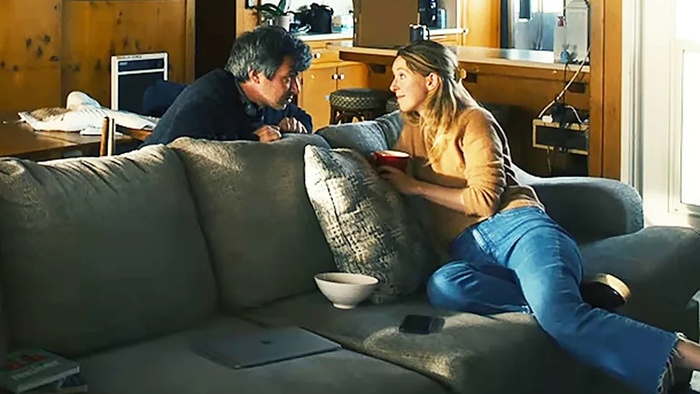
“… The crew films them, reality-show style, around the clock …”
Evans tries to present himself sympathetically, but he’s an amateur compared to Holmes, and the mask slips, revealing an arrogant, angry, controlling individual. There is a surprise about halfway through the film that turns the whole thing on its head, and results in Fielder becoming a subject of the documentary himself. Neither Fielder, nor the viewer, can be sure whether or not they’ve been emotionally exploited.
Holmes is in prison for fraud, but tech bros routinely overpromise on their results when raising capital. Her partner in crime Ramesh “Sunny” Balwani, was also convicted and received a similar sentence, but most male entrepreneurs avoid prosecution for overhyping technology. Working in the tech world one often hears “don’t confuse sales with delivery.” Was she merely marketing their idea? While it’s true that the device would have wreaked havoc on public health if they had not been stopped, making an example of Holmes while letting others slide is unethical.
The documentary is complex and layered, and even at three hours runtime demands several viewings to take it all in. It’s not clear that Fielder knew where this would go, but he and Oppenheim have created an accidental masterpiece. It will continue to be discussed and dissected, and it is roaring into awards season putting the competition notice. This year could be the A24 show, with a guest appearance by Christopher Nolan and The Odyssey.
You Can See Everything is a brilliant and terrifying study of narcissism, emotional manipulation, Stockholm syndrome, and the casual, breathtaking inhumanity of the wealthy. It also begs the question whether someone is lying if they believe what they’re saying, despite proof that it’s not true. Holmes says she’s shown us everything, but we can be sure of nothing.