
Last summer, this column offered counterprogramming to the blockbuster season, and as we find ourselves in the thick of a robust slate of summer movies, it only feels right to do the same again.
Think of these as the should-be blockbusters: films that share a similar qualities inherent to tentpoles (epic, operatic, fraught with grave stakes), but funneled through the grand, strange and sometimes darkly funny visions of auteurs wrestling with weighty ideas coursing through the mayhem.
‘Aguirre, the Wrath of God’ (1972)
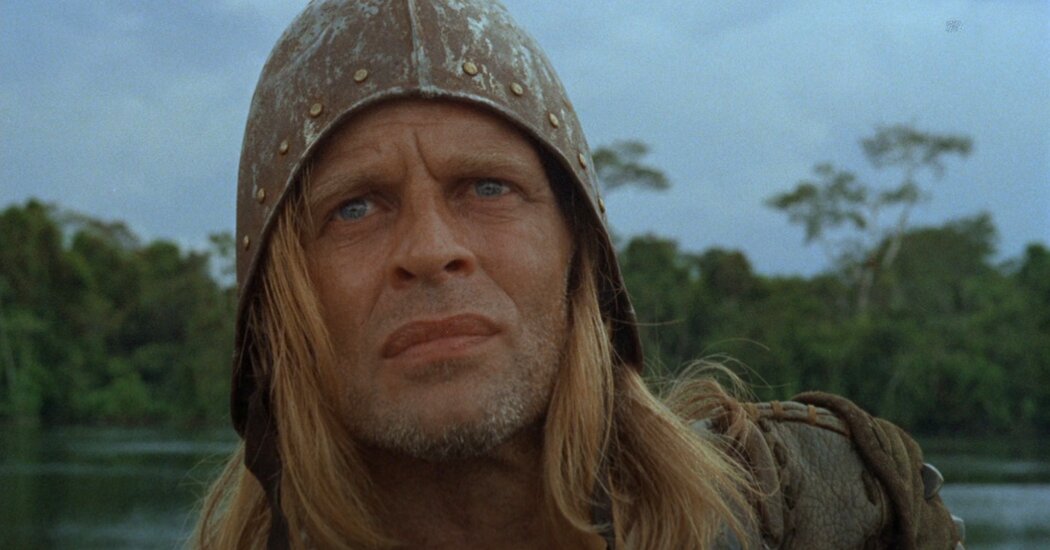
Like an impossible dream, the trail of men descends from the clouds on Christmas morning. This is how Werner Herzog’s epic begins before devolving into an enduringly fascinating plunge into madness.
The film, about a group of explorers searching for the treasures of El Dorado and strung along by the Spanish conquistador Don Lope de Aguirre (Klaus Kinski), is a sweat-soaked meditation on the delusions of men, willfully drunk on power and fantasies of fortune. Off they stubbornly push into their own heart of darkness, even if it leaves them delirious and dead. Starting in the clouds, the movie ends with monkeys swarming cannons, bodies strewed everywhere, and a pacing Aguirre still muttering about worlds to conquer, treasures to discover.
History, its violence and what we often call its progress, is shaped by these men. (So too are great films: You can sense the madness onscreen is also a document of the infamously difficult production.) But this story, an inspiration to other grim epics like “Apocalypse Now,” is also both funny and uneventful. It’s a treatise on colonialism that is partly brilliant for showing the daily reality of conquest: hungry fools just sitting, waiting and wasting away.
This might be the quintessential New York movie. Here is a vision of the city as it perhaps really exists: its motley arms — its cops and criminals, its politicians and people, its transit riders and operators — interacting and working together, all while being unendingly irked with one another. It’s a movie, in other words, about being stuck on the subway.
But at its core this is an old-school thriller, and one that’s all the better for its age. Directed by Joseph Sargent and following a group of subway hijackers holding its riders hostage, it’s the kind of tactile ’70s caper where the subway control room is as thrillingly atmospheric as the hostage room.
Yet it’s as funny and charming as it is gritty because of all the men (including Walter Matthau) in those very rooms. They are the kinds that were everywhere, enlivening the screen, in the ’70s: profane, weathered beyond their years and first-rate performers who all looked like your gruff neighborhood plumber.
Is this really all there is? When Gawain (Dev Patel), shuddering at death’s door, asks this, he has traveled far and wide: He has been robbed, aided a ghostly saint, walked among demigods, been seduced by a lady temptress — all to add up to him willingly bending himself over a chopping block. Do we live out adventures simply because the stories tell us to? And do we then just offer our heads because some arbitrary ideal of honor says so?
“What else ought there be?” So replies the Green Knight (Ralph Ineson) to Gawain. David Lowery’s entrancing tale about the adventures of young Gawain finding the stuff of knighthood seems at once ambivalent to and fascinated with this answer to the course of life and history.
Lowery’s masterwork is among the most elegant and formally transportive works of fantasy in recent years, but it’s most ambitious and peculiar as a fable about the random, yet meaningful pull of fables. Men see and do great and grave things. They encounter magic in the woods, are prone to folly, find greatness and tell tales of it or are beheaded — all because the stories tell us to. What else ought there be?
There are fancy superlatives one can conjure to define the majesty and tragedy of Akira Kurosawa’s masterpiece. They would all feel reductive. The better way to describe it is to flip the definition, to say that it is the film itself that appears to define those elemental ideas: words like epic, or color, or cinema, or Shakespeare.
A loose adaptation of “King Lear,” Kurosawa’s monumental saga chronicles the fallout of a king’s sudden decision to cede his authority and land to his sons. The swift chaos that ensues can feel paradoxical, flitting between the intimacy and self-containment of a parable that feels like it’s playing out on a theater stage, intercut with blood-soaked set pieces of staggering sweep and grandeur. Saying more pales in comparison to experiencing this opus, of scale and motion, sound and color, which speaks for itself.
A two-hander made up of one star, this is a streamlined space movie buoyed by Sam Rockwell. He plays Sam Bell, a solitary man on the moon who is on a three-year contract to run a mining operation for an energy company. But in the final days of his stint, his mind begins to fray and an accident leads him to wake up to another identical Sam Bell aboard the station. Cue the existential crisis.
You’ll see shades of other sci-fi films blended up in here, and the film, directed by Duncan Jones, has the self-contained quality of a short story of sci-fi cinema rather than a sweeping space opera. But that can be its own reward on a low-budget work like this, which stretches its dollar to build a complete world and has the charisma of a performer like Rockwell to sell it.