
To audition to play the teenage Elle Woods, heroine of Amazon Prime Video’s prequel series to “Legally Blonde,” Lexi Minetree put on a pink bikini and reclined in a hot tub. Then the fun began.
Inspired by a scene in the 2001 movie, in which a swimsuit-clad Elle (Reese Witherspoon), submits a video application to Harvard Law School, Minetree lists off her own qualifications: staying fit (she hoisted two-pound weights); learning new, detail-oriented skills (she crocheted on camera); and juggling her various interests (she literally juggled limes — “I’m a hobby collector,” she told me).
“It was absolutely ridiculous,” Minetree said of her tape over coffee in Manhattan recently. “But in the best way — in Elle’s way, because she is ridiculous, because she doesn’t care about being cringey. She just is herself and owns it, which I love.”
And it worked: Minetree, now 25, a little-known actress from the suburbs of Atlanta, landed the high-profile starring role in “Elle,” which begins streaming on Wednesday. “When I saw her tape, I was like, are we the same person?” Witherspoon, who conceived the series and executive produced it, said in a video with her plucky-chinned look-alike.
Minetree (pronounced MIN-eh-tree) radiates Elle vibes in other ways too — what Lauren Neustadter, an executive producer of the series, called “the combination of being incredibly diligent and incredibly optimistic.”
Those qualities stretch far: The “Legally Blonde” universe already spans the original novel, two movie sequels and a Broadway musical. In the quarter century since Elle Woods appeared as a thoroughly accessorized, preternaturally confident sorority girl who battles blonde stereotypes and a rotten ex-boyfriend to propel herself to the top of her law school class, the character has become a huge feminist icon. “What, like it’s hard?” might as well be embroidered on the backpacks of every overachieving coed. (And there are a lot of them in Elle’s wake; Witherspoon has said that women — who now make up the majority of law school students — routinely tell her they were inspired to attend after seeing the movie).
But Elle Woods didn’t just emerge strutting in her Jimmy Choos. What the “Elle” creators wanted to capture was how she arrived at that sparkplug energy as she grew up. “She is who she is in the movie,” said Laura Kittrell, a showrunner. “She just can’t be fully formed.”
In the series Elle is still self-conscious enough to worry about what others think of her. As a 16-year-old girl, “you internalize what people say,” Kittrell said. “The thing that Lexi brings is that vulnerability.”
The series is set in 1995, the year the Elle of the movie would have been a junior in high school. After her family’s circumstances change, Elle and her parents (Tom Everett Scott and a scene-stealing June Diane Raphael) leave her natural surroundings — the luxe life and serious shopping of Bel Air, Calif. — and land in peak grunge-era Seattle. Perky and pink doesn’t fly there; Elle earnestly bedazzles a Nirvana tee only to be rewarded with the worst ’90s epithet: poser. She struggles mightily to fit in and to comprehend an environment where everything is not clear-cut and cushy.
“She’s kind of learning in real time, oh, maybe the world is different than I once experienced it,” Minetree said. “Maybe I care about different things that I didn’t even know I should care about.”
Growing up, the eldest child in a blended family with her mother and stepfather, both accountants, Minetree was a bookworm — “I won this award for reading the most books in the entire school” — who found her tribe among the theater kids. “That’s where I learned to feel most myself, or my favorite version of myself,” she said.
She graduated from U.S.C. with a double major in theater and public relations, landed the requisite young-actor “Law & Order” credit and got a taste of being first on the call sheet on Lifetime movies like “The Paramedic Who Stalked Me” and “My Amish Double Life.”
“Subtle, I know,” she cracked.
But comedy was new to her, and at 5-foot-2 — about the same as Witherspoon — she worried about doing it in six-inch heels. “I don’t know if you can see the fear in my eyes,” she said of an early scene where she (successfully) totters down stairs. (Like all her young castmates, she also had to learn how to use an old-school phone.)
Minetree doesn’t recall the first time she saw “Legally Blonde” — she was born just before it arrived in theaters. “I just remember that it was kind of a comfort movie, especially as a young woman,” she said. “It was so empowering to watch.”
Others who came of age with Elle Woods felt her influence deeply. “It changed my life,” Neustadter volunteered. “Seeing that she was underestimated and sometimes misunderstood, but that belief in herself and determination and perseverance could actually lead to tremendous accomplishment — I think that really set me on my path.” She is now Witherspoon’s producing partner at the media company Hello Sunshine.
The idea for the series came from a conversation the two had in 2023 about teenage girls and the negative messages they receive on social media and elsewhere, with deleterious effects on their sense of self-worth. “Reese was the one that said, ‘I think this generation needs Elle Woods,’” Neustadter recalled. Within a few months, they had sold the series to Amazon.
The first season is stuffed with one-liner references and fan service, like the moment Elle got and named Bruiser, her Chihuahua (a fellow “Gemini vegetarian”). A second season has already been filmed.
Minetree didn’t just parrot the movie’s admissions tape. A natural brunette, she had gone blonde on a whim a few months before the open casting for the show was announced. (Around 5,000 people applied.) She immediately had a friend take headshots of her new look — pink outfit, golden waves — to post on her IMDB listing.
“My P.R. brain kicked in,” she said. “If they looked me up, I wanted them to see Elle. I didn’t want to give them a single reason” to pass. (Anticipating and navigating around people’s perceptions — a very Elle Woods move.)
Then there were her binders full of notes — tabbed, color-coded, constantly re-collated. “This very confusing system,” laughed Caroline Dries, the other showrunner. But it was effective: Before the first day of shooting, when many actors barely know their own lines, Minetree had memorized the scripts for all eight episodes.
The producers still sounded shocked talking about it, especially because Minetree was in nearly every scene, with dialogue-heavy material. “She’s never going to have this many words a minute unless she’s in a David Mamet play,” Kittrell joked.
After long days of filming — Vancouver stood in for Seattle — Minetree holed up in her hotel gym, poring over her binders while on the treadmill. (Elle’s study habits, to a tee.) She worked with a vocal coach to master the character’s distinctive cadence: bright, airy, bouncy and yet “not like a Valley Girl,” Minetree emphasized.
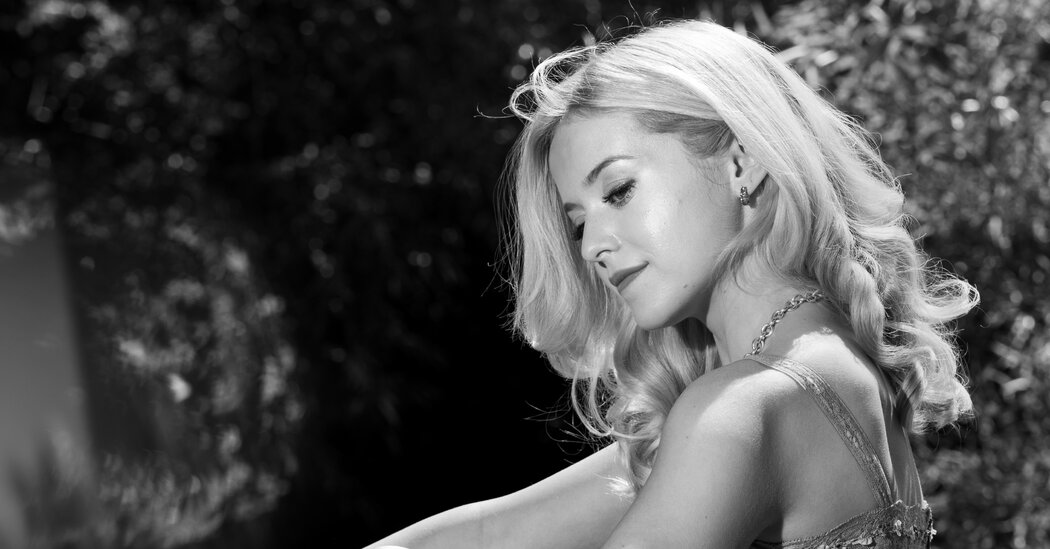
Kittrell and Dries compared her to Lucille Ball in her delivery and physical comedy; in the photo shoot for this article, she bounded barefoot up rocks in Central Park, while wearing a diaphanous slip dress — a nymph with a bouldering habit.
“Elle is sort of the heightened thing in the show, and then everything else around her is fairly grounded,” Dries said.
Raphael, the comic actress (“Grace & Frankie”), whose character is meant to be a stand-in for the generation of women who did grow up with Elle, said she was “blown away” by how well Minetree handled being a leader on set and by her portrayal.
“It’s not an impression. It is her offering her own humanity and past and history to this character,” she said, “dealing with the sort of mania of hormones, and what you go through as a teenage girl.”
Minetree, who moved to New York after college and still lives with two roommates in a Brooklyn apartment, knows her life may change imminently, even if she can’t quite believe it. Getting recognized on the street — “I can’t imagine what that would be like,” she said, blue eyes wide. But she hopes to approach it with the unabashed moxie (or the cringe) of Elle.
“I want to take my work seriously,” she said. “But not myself.”
Alexis Soloski contributed reporting.