
I have always struggled with the way films are usually planned. When I start one, I almost never start at the beginning. Sometimes I can see the ending clearly but not how it opens. Sometimes I know the first scene and then I am holding five versions of what could come next, all at once. I will know the look before I know the story.
The thing is, almost every tool we plan with is built for a straight line. A script is a column, a timeline is a row, a deck is one slide after another, and they all assume you already know the order. I usually do not. Linear thinking is like the layers and tracks in a video editor, stacked and sequential. Nonlinear thinking is a canvas, where things live wherever they make sense and connect in any direction. I am the second kind, and rather than keep forcing myself into the first, I built a tool that works the way I do and called it Beat.
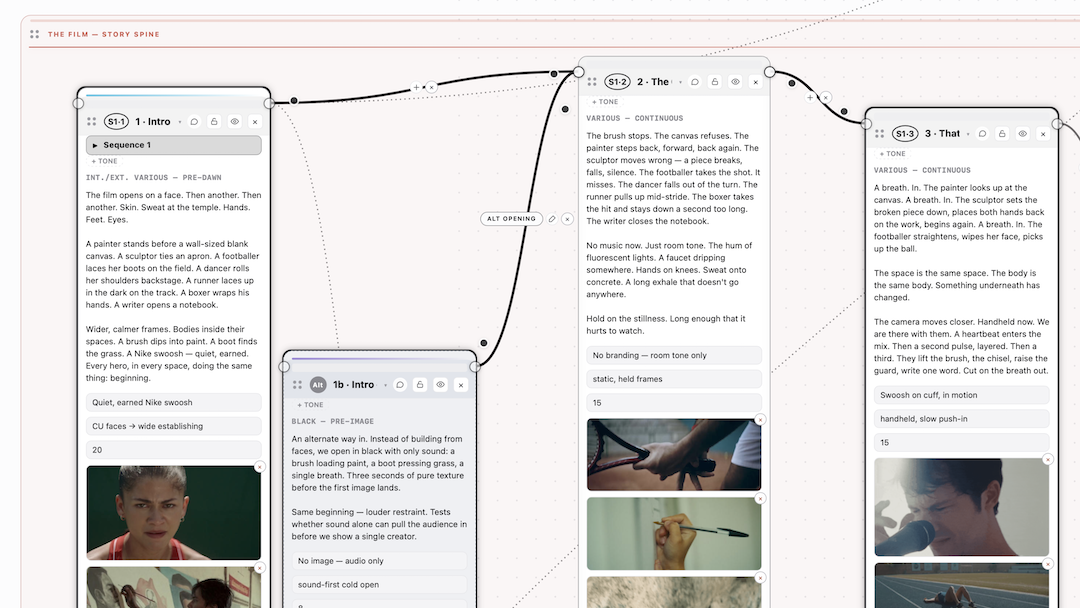
Beat: a whole film on one canvas, with the reference vault on the right.
I did not build it to sell anything. I built it for myself, to get the mess out of my head and onto something I could see. Then I showed it to a friend, that friend showed another, and people in the production houses I work with started using it on real jobs. At some point it stopped being my private thing and became a thing.
I made it free on purpose. I believe in building a community around it, and that is where Beat really wins, because every version gets better when someone tells me what is missing. I am not driven by money here. I am driven by sharing something I made for myself and seeing what other people do with it. I will not pretend it is pure generosity either, since having it spread is good for my career too. But mostly I want it to be useful, to everyone in this industry and to creative people in general.
The way I work with it is the same way I think. I open a blank canvas and drop in whatever I already have. The ending I can picture, a line of dialogue, a location, a reference image that gave me the mood. Loose cards, no order. Then I connect them, and when I am holding two versions of a scene I keep both and branch them instead of deleting the one I am not brave enough to use yet. Everything sits in one place, the references next to the beat they belong to, the characters, the locations. When I know exactly how I want to stage a shot I build a Set Plan, an overhead view of the blocking, the camera and the light, and that becomes the thing I hand my DP or a client. I can also connect the board to Claude and let it read the whole thing and give me real production insight.

The Set Plan: an overhead view of blocking, camera and light you can hand straight to a DP or a client.

Link to Claude: it reads the whole board and gives real production notes.
The clearest proof is a film I made for a Brazilian jewelry brand, the Marina Vicintin project. We had a small budget and wanted it to look like we did not. It cuts between timelines that get woven together in the edit, and they had to feel continuous even though they were shot apart, so seeing every thread at once was the only way I could hold it in my head. Some shots were enhanced with AI, which meant tracking which ones and how, and Beat made that easy. The honest twist is that the first version of Beat was built while I was making that film, so I was building the tool and depending on it on a real job at the same time.
That is really all Beat is. A free Mac app, a canvas where you plan a whole film, with your beats, references, characters and locations, the look, branching versions of a scene, a Set Plan you can share, exports to Word or an outline, and a live link to Claude. No account, it runs on your machine, and it is not for sale. If your head works in pictures and out of order, that is not something you need to fix. The tools were built for linear minds, and for a long time there was nothing for the rest of us. You can plan something that looks expensive on almost no money if you can finally see all of it in one place. I built the thing I needed and gave it away, and I would love to see what you make with it. It is at beatforfree.com if you want it.

Everything stays structured in an editable outline you can export to Word.

Joao Lutz is a director and creative director represented by Creme Company, part of the Boiler hub. He was based in New York and now works out of Sao Paulo. Find him on Instagram at @____lutz.
Related