
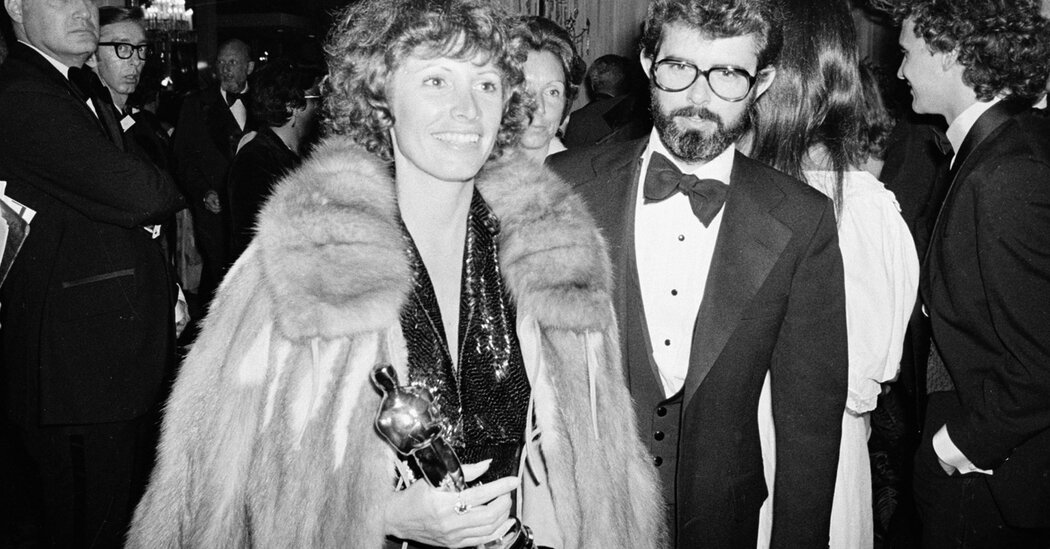
Marcia Lucas, a film editor and important collaborator on the early movies of Martin Scorsese and George Lucas, her first husband, who won an Academy Award for her work on “Star Wars,” died on Wednesday at her home in Rancho Mirage, Calif. She was 80.
The cause was cancer, Deidre Von Rock, the lawyer for her estate, said.
In the late 1960s, while working with the editor Verna Fields, Marcia Griffin, as she was known then, was assigned to train a newly hired film school graduate named George Lucas.
They fell in love and, in 1969, married. Ms. Lucas edited and influenced her husband’s early blockbusters, including “American Graffiti” (1973) and the first “Star Wars” movie (1977), for which she, Paul Hirsch and Richard Chew won the Oscar for best editing.
Ms. Lucas was the one who suggested to Mr. Lucas that, contrary to early drafts, Obi Wan-Kenobi should die in his dramatic lightsaber fight with Darth Vader.
She helped lend clarity and pacing to a climactic battle, and insisted on the inclusion of a kiss between Luke Skywalker and Princess Leia. The character of Chewbacca — the giant, hairy co-pilot of the Millennium Falcon alongside Han Solo — was inspired by Ms. Lucas’s habit of driving with the couple’s Alaskan malamute, Indiana, in the passenger seat.
Ms. Lucas was “the warmth and the heart” of Mr. Lucas’s first big movies, Mark Hamill, who played Luke Skywalker, said in a 2005 interview with Film Freak Central.
Yet after helping to edit the third “Star Wars” movie, “Return of the Jedi” (1983), she divorced Mr. Lucas and left the industry.
Marcia Lou Griffin was born on Oct. 4, 1945, in Modesto, Calif. Her father, Thomas, an Air Force officer, left the family when she was 2; her mother, Mae (Ebeling) Griffin, was a clerk at an insurance agency.
Marcia grew up mainly in North Hollywood, in the San Fernando Valley, and began working in the movies by chance, when an employment office directed her to a film library. She found that she liked the work so much that she would have “cut film for free,” she told Brian Jay Jones for his 2016 book “George Lucas: A Life.”
Mr. Lucas’s first feature, “THX 1138” (1971), an expansion of a sci-fi student project, didn’t excite the studio and flopped commercially. Ms. Lucas later said that she was not surprised.
“I like to become emotionally involved in a movie: I want to be scared, I want to cry,” she told Peter Biskind for his book “Easy Riders, Raging Bulls: How the Sex-Drugs-and-Rock ’n’ Roll Generation Saved Hollywood” (1998). “I never cared for ‘THX’ because it left me cold.”
Telling Ms. Lucas that he intended to show just how much he could emotionally involve the audience if he wanted to, Mr. Lucas shopped around a new screenplay. Studios weren’t interested, but offered him lucrative contracts to direct other people’s work. The couple were living mostly on what Ms. Lucas was earning as an editor, but she pressed him to hold out and wait until he got financing for his own film.
He finally wrangled a modest budget of $750,000 to make that movie, “American Graffiti,” with Ms. Lucas signed up as an editor alongside Ms. Fields, their old boss.
It earned a stunning $177 million — making it, in the estimation of Dale Pollock, the author of “Skywalking: The Life and Films of George Lucas” (1983), the movie with the highest-ever profit per dollar invested. Ms. Lucas and Ms. Fields were nominated for an Academy Award.
The Lucases’ careers took off. Ms. Lucas worked on Mr. Scorsese’s “Alice Doesn’t Live Here Anymore” (1974), “Taxi Driver” (1976) and “New York, New York” (1977), which overlapped with “Star Wars.”
Mr. Lucas’s space fantasy earned more than $400 million at the box office and won six Academy Awards. Hopeful after the smash, Ms. Lucas made a prediction to People magazine about the couple’s next project: “Getting our private life together.”
Instead, Mr. Lucas confronted a clause in his contract stipulating that he had to start a sequel within two years to retain his rights to the franchise.
“My wife likes to have vacations,” he told Starlog magazine at the time. “It always comes down to saying, ‘Next week. Just let me get past this thing….’ By the time you get past this thing, there’s always something else.”
Mr. Lucas conceived and produced the first Indiana Jones movie, “Raiders of the Lost Ark” (1981). Watching a cut late in the production process, Ms. Lucas noticed that the movie’s love affair had been left unresolved. The crew got back together to shoot a take that became the new penultimate scene.
After she finished her work on “Return of the Jedi,” Mr. Lucas told her that she was “a pretty good editor,” she recalled to Mr. Biskind. “I think that was the only time he ever complimented me.”
Ms. Lucas said she had believed that they were partners in work and life — she “the more emotional person who came from the heart” and Mr. Lucas the visual thinker and intellect.
But “in his mind,” she added, “I always stayed the stupid Valley girl.”
The couple had bought an enormous ranch outside San Francisco. A young artist, Tom Rodrigues, was working on a stained-glass dome above the library, and he and Ms. Lucas became romantically involved. She asked for a divorce.
Mr. Jones, Mr. Lucas’s biographer, reported that Mr. Lucas agreed to give her around $50 million so he could keep the ranch.
Matthew Robbins, a friend of Mr. Lucas’s, told Mr. Biskind that the director was crushed by the divorce. “It violated all of the small-town traditions and virtues, all his certainties about himself,” Mr. Robbins said.
Ms. Lucas and Mr. Rodrigues were married for several years before divorcing. Ms. Lucas is survived by their daughter, Amy Soper; another daughter, Amanda Hallikainen, whom she and Mr. Lucas adopted; and three grandchildren.
Mr. Jones wrote in his biography that Ms. Lucas’s contributions to her first husband’s films were “all but erased from most Lucasfilm-sanctioned histories.” (The production company, which Mr. Lucas founded in 1971, said in a statement that it was “deeply saddened” by her death.)
“He wanted to stay on that workaholic track,” Ms. Lucas said of her first husband. “The empire builder. The dynamo.”
Her idea of success was different.
“I felt that we paid our dues, fought our battles,” she said. “I wanted to stop and smell the flowers. I wanted joy in my life.”