
Back when it was known simply as “Star Wars,” the movie that changed the world — and launched George Lucas’s ever-expanding universe of mythical sci-fi — seemed as born for the big screen as any movie of its era. “Star Wars” said to its fans: Here’s a swashbuckling Zen space opera of irresistible vastness — a world large enough to colonize your imagination. To do that, “Star Wars” needed to be epic, and was.
But by the time “The Mandalorian” came along, in 2019 (42 years after the original movie), the world of “Star Wars” had expanded to the point that in its very omnipresence, as well as its hyperactive digital-age busy-ness (a quality launched with “The Phantom Menace” in 1999), it felt larger than ever…and also smaller. More had become less. That’s why “The Mandalorian,” created by Jon Favreau as the “Star Wars” universe’s first live-action television series, was the perfect solution to what had become The “Star Wars” Problem.
The prequels, then the sequels, were all trying — oh, were they trying — to be true “Star Wars” movies. Yet the bar had been set impossibly high. A couple of the later films were all right, a number were not, to the point that the sound of fans fighting about them (“‘The Phantom Menace’ sucked!” “I felt the thrill again with ‘Revenge of the Sith’!” “‘The Force Awakens’ was chintzy fan service!” “‘The Last Jedi’ was great!” “No, it was a mess!” “‘The Rise of Skywalker’ was too woke!”) may have produced more dramatic sparks than anything in the films themselves. My own attitude always came down this: The “Star Wars” brand had become an industry — but none of these movies could ever truly recreate what “Star Wars” and “The Empire Strikes Back” had.
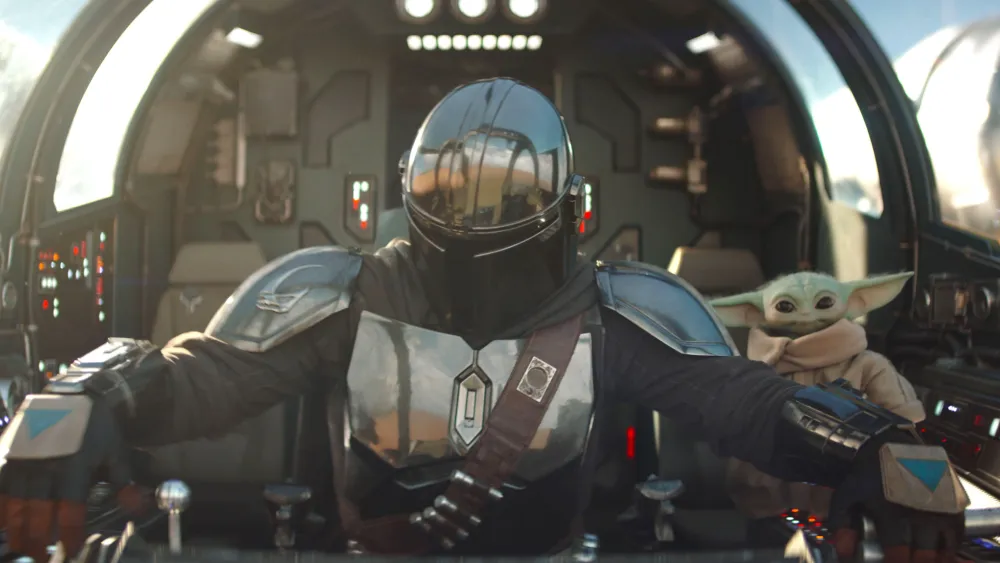
Yet part of the low-key, shaggy-dog success of “The Mandalorian” is that it didn’t try to. The small screen was arguably the perfect home for repackaged “Star Wars” nostalgia that didn’t pretend to be anything else. Whereas the movies showcased dynastic battles and striving, conflicted characters who were increasingly grandiose, the hero of “The Mandalorian,” a bounty hunter who almost never takes off his helmet of gleaming beskar, is a character who would have been listed 15th in the credits of a “Star Wars” movie — and, in fact, he was essentially spun off from the armored figure of Boba Fett, who started out as a supporting gunslinger in “The Empire Strikes Back” and “Return of the Jedi.” But that made the Mandalorian the perfect figure of lightweight gravitas to anchor a TV series; it was like watching a sci-fi version of “The Virginian” or “Kung Fu” or “Baretta.” And in “Star Wars: The Mandalorian and Grogu,” the deluxe movie version of the series, he’s every bit as cozy and compact a figure.
The Mandalorian, whose real name is Din Djarian (but he’s usually called Mando), is a slightly forbidding dude in dark armor and a geometric breastplate, with a voice of ominous neutrality that’s been slightly electronically altered, which gives him a mild Darth Vader echo, though this is no villain — he’s more like Darth Nicer. In his gun-wielding invincibility, he may remind you a bit of RoboCop, though with a flourish of “Star Wars” valor; call him Han Robo. On the rare occasions when he takes off his helmet, we see the mustached face of Pedro Pascal, who is such an agreeable actor that you may have trouble re-imagining him as a badass.
And though Din Djarian has a touch of revenge-thriller mercilessness about him, that’s more than offset by the fact that his apprentice and symbolic son is Grogu, an infant member of the same humanoid-alien species as Yoda. Grogu never speaks; he just coos like the Snuggle Bear from the fabric-softener commercials. But what I’ve always found slightly absurd about him is that in “The Empire Strikes Back,” the whole idea of how Yoda looked — shriveled skin, wisps of white hair, deeply furrowed high forehead — emerged from the fact that he was a wizened, ancient, 900-year-old master of the Force. He was a very old man. So it makes absolutely no sense that an infant version of him — a character originally known as Baby Yoda — would look like that. (Yoda’s furrows reflected 900 years of thinking.) I bring this up only to make the point that that’s how possessed the Lucas universe had become with creating toys and dolls to market.
All that said, Grogu, like Din Djarian, is what he is: an unabashed TV-friendly mascot-product. These two were made for the small screen, where they can intersect with the narrative tentacles of other “Star Wars” series, like “Ahsoka” and “The Book of Boba Fett.” The ironic reason I would say they translate just fine to the big screen is that they bring with them our collective sense of lowered expectations. I found “The Mandalorian and Grogu” to be fun in a slightly flat way. But because the movie has so little pretense, it’s basically an invitation to wallow in the lite “Star Wars” nostalgia that’s there in every frame.
In the opening set piece, Mando, who has been hired to hunt down the remnants of the Empire forces that are still scattered across the galaxy (the film is set roughly a year after the end of the original “Star Wars” trilogy), invades one such enclave. He shoots the place up and lays waste to a couple of All Terrain Walkers — the dinosaur-like giant armored combat vehicles that were so cool in “The Empire Strikes Back,” and that now adorn the series like an iconic hood ornament. This battle has spectacle, but the rest of the movie is really a crime thriller in “Star Wars” drag.
Back at the New Republic base camp, Mando is given a mission by Col. Ward, played by newcomer Sigourney Weaver with a snappish “Yes, I belong in a ‘Star Wars’ movie…but not totally” hauteur. He’s to journey to Nal Hutta, swampy home planet of the Hutts, and arrange to rescue Rotta the Hutt (son of the deceased crime lord Jabba the Hutt), who has been taken prisoner. Rotta is voiced by Jeremy Allen White with a cocksure geniality that makes him the first bro Hutt. Mando will return Rotta in exchange for a crucial piece of information. At least, that’s the plan. But you can’t trust the Hutts. And who would, given that every one of them looks like the Creature from the Black Lagoon crossed with a giant slug melted into a pile of excrement?
Rotta has been made into a gladiatorial fighter, bound to a contract by Janu (Jonny Coyne), the warlord gangster. Mando frees him soon enough (after a funny encounter with a four-armed simian food-truck chef voiced with high anxiety by Martin Scorsese). He also succeeds in capturing Janu, though that just sets up the film’s real battle: between the Mandalorian and Grogu and Rotta’s relatives, known as the Twins. They have plenty of power to unleash on Mando, who will be placed in a water pit, where he faces off against a dragon-snake (a very fleshy set of jaws), who bites and poisons him, which means it’s now up to Grogu to rescue his master, which he does with the aplomb of an even more cuddly Ewok.
Will audiences go into “The Mandalorian and Grogu” expecting a full-blown “‘Star Wars’ movie?” I’d say yes…and no. Will they turn out for it in the requisite numbers? By nudging “The Mandalorian” onto the big screen, Disney, the purveyor of the “Star Wars” multiverse, is offering nothing more (or less) than a couple of likable, diverting, semi-forgettable episodes jammed together, albeit with the lavishly scaled action of a big-budget movie adventure. Yet there’s no escaping that “The Mandalorian and Grogu” comes at us with a tidy small-screen consciousness. The upshot is that maybe that’s what “Star Wars” now is.