
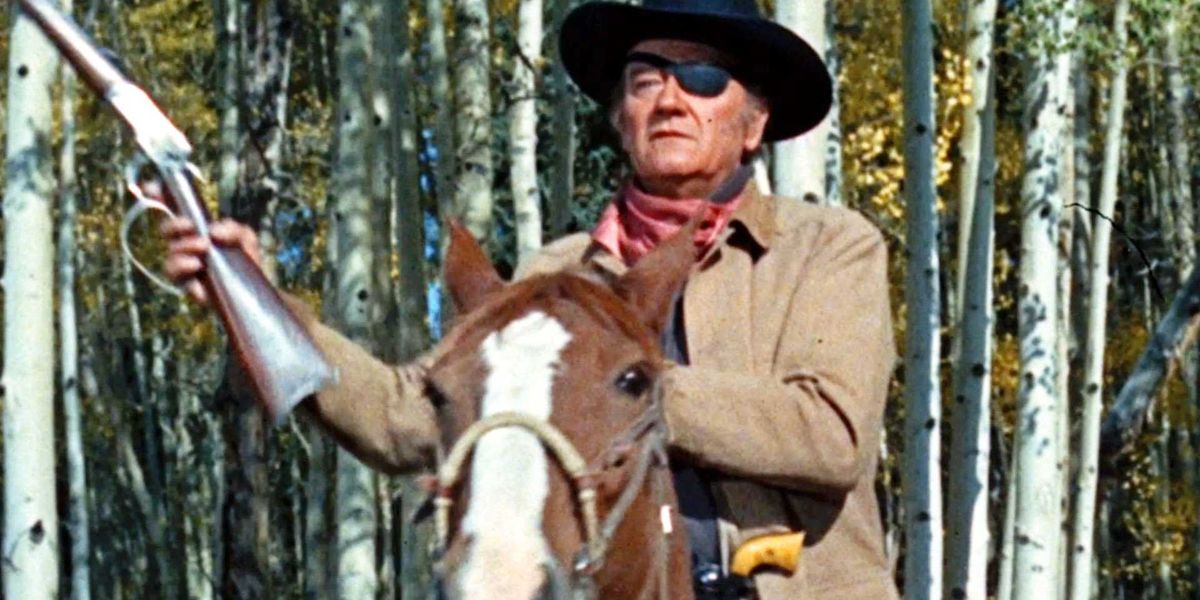
I’m not sure there’s an actor synonymous with one genre the way John Wayne is with Westerns. He spent decades defining the genre, playing stoic heroes in cinematic landmarks like The Searchers and Stagecoach.
There is no American myth without him, and despite a complicated legacy, he is one of Hollywood’s biggest stars ever.
And despite carrying the Western genre on his back for nearly half a century, “The Duke” won exactly one competitive Academy Award in his entire career. And it wasn’t for a sweeping, poetic John Ford masterpiece.
It was for Henry Hathaway’s 1969 Western, True Grit.
Let’s dive in.
– YouTubewww.youtube.com
The Man, The Myth, The Eye Patch
In True Grit, Wayne stepped into the dusty boots of Rooster Cogburn, and maybe the best of Wayne came out.
He was used to playing heroes, but this was a distinct antihero.
Cogburn was a fat, one-eyed, hard-drinking, trigger-happy U.S. Marshal who was hired by a fierce 14-year-old girl named Mattie Ross to track down her father’s killer.
Wayne lumbered in not as the moral compass of the movie, but the person willing to embody the lawless nature of the Wild West via lawman.
Yet, it worked beautifully.
The performance balanced broad comedy with genuine menace. You got several different classic character archetypes while completely subverting expectations of who we knew Wayne as, and these characters are well.
The reason this movie works so well is that Wayne’s chemistry with Kim Darby (Mattie) and a young Glen Campbell (La Boeuf) really brought out the subtle aspects of the story that gave each person more to play with in their performance.
Old Hollywood vs. The New Wave
To understand why Wayne won the Oscar at the 42nd Academy Awards in 1970, you have to look at what was happening to the film industry at the time.
Hollywood was undergoing a massive seismic shift. The “New Hollywood” era was exploding, bringing gritty, counter-culture, avant-garde films to the mainstream.
Just look at who Wayne was up against in the Best Actor category that year:
- Dustin Hoffman – Midnight Cowboy
- Jon Voight – Midnight Cowboy
- Peter O’Toole – Goodbye, Mr. Chips
- Richard Burton – Anne of the Thousand Days
Midnight Cowboy actually went on to win Best Picture, cementing a massive shift in how Hollywood viewed independent filmmaking styles.
And even the mythos of the genre that Wayne had created.
But the town wasn’t quite ready to let the past go.
Wayne had recently survived a brutal bout with lung cancer and had lost a lung and several ribs in the process. He was the titan of a dying era of studio filmmaking that many voters viewed as a literal last gasp from that older era.
Wayne won his Best Actor Oscar and did so, showcasing a vulnerable side that I’;m not sure the town had seen or knew was in him.
– YouTubewww.youtube.com
The Duke’s Own Take on the Win
Here’s a fun piece of trivia that might surprise you: John Wayne didn’t even think True Grit was his best work.
In a brutally honest 1971 interview with Playboy, Wayne admitted that he didn’t consider the film to be in his personal top five.
Instead, he favored his collaborations with legendary directors like John Ford and Howard Hawks, mostly because those films required much tighter blocking and directing techniques to build tension.
And for me, I think his best performance was in The Shootist, which was his final film and is worth checking out.
1969 vs. 2010: A Tale of Two Roosters
Of course, True Grit was remade by the Coen brothers in 2010, and they absolutely nailed it, too.
They cast Jeff Bridges as Cogburn in their 2010 adaptation. For anyone studying the art of the remake, comparing these two versions is a goldmine.
I think they’re both great for distinct reasons, and they show how each filmmaker took Charles Portis’s novel and made it their own.
And I think it says something that each actor was given a chance to win an Oscar for the Rooster role.
| Feature | 1969 Version (Henry Hathaway) | 2010 Version (The Coen Brothers) |
| Tone | Colorful, bombastic, traditional Hollywood Western | Bleak, historically accurate, darkly comedic |
| Rooster Cogburn | Larger-than-life, charismatic, heroic despite flaws | Gruff, washed-up, borderline incoherent but lethal |
| Mattie Ross | More subservient to the Hollywood star dynamic | The true, uncompromising protagonist of the film |
| Oscar Performance | John Wayne (Won Best Actor) | Jeff Bridges (Nominated for Best Actor) |
Summing It All Up
John Wayne’s Oscar win proves a fundamental truth about the entertainment industry: star power, a good industry narrative, and subverting your own brand matter just as much as any sort of marketing.
If you can get people to buy in, you will not only have a hit on your hands, but you’ll have an awards movie that can enter the annals of history.
Let me know what you think in the comments.