
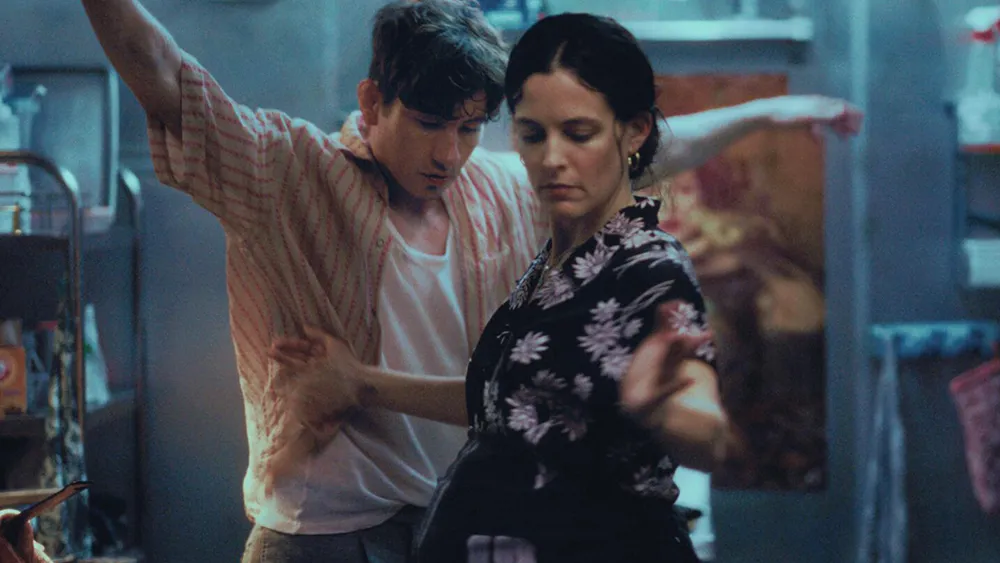
As earthly circles of hell go, modern-day Newark is in an altogether different, gentler category from post-WWII Leningrad. Still, in Kantemir Balagov‘s long-awaited third feature “Butterfly Jam,” industrial New Jersey proves as vivid and specific a backdrop for wilting, marginalized lives as the ruined Russian city did in the filmmaker’s 2019 masterpiece “Beanpole.” Though it’s the Russian director’s first American-set work, he’s not as far from home as initially appears to be the case: A finely textured immigrant community study that engages meaningfully with his own Circassian heritage, “Butterfly Jam” is marked by unsentimental kinship with the rowdy, not-quite-settled expat family at its center, even with actors as unexpected as Barry Keoghan, Riley Keough and Harry Melling playing the parts.
But if the film knows its characters like the back of its callused hand, the story in which it places them sometimes unfolds with less conviction and credibility. An agreeably shaggy, meandering, mood-driven portrait until a startling act of violence that recalibrates proceedings entirely — a comparable jolt to the one that stunningly stopped “Beanpole” in its tracks, though far later and more wayward in its fallout — “Butterfly Jam” is most rewarding at its most relaxed, when Balagov’s flair for movement, ambience and particularity of place is most generously on display, in tandem with “Nickel Boys” DP Jomo Fray’s propulsive camerawork. The opening film of this year’s Cannes Directors’ Fortnight program, it will likely prove more divisive than the filmmaker’s previous work, though his prodigious formal gifts are not up for debate.
Co-written with Marina Stepnova, “Butterfly Jam” was originally intended to be set in Balagov’s North Caucasus hometown of Nalchik, before the director’s condemnation of Putin’s war on Ukraine necessitated his exile to the U.S. The finished film doesn’t feel awkwardly retooled from that initial conception: It’s persuasive as an evocation of immigrant displacement and not-belonging, while Keoghan and especially Keough bring an air of resigned outsider status to their performances as Circassian siblings who were brought to New Jersey by their mother as teens, only to swiftly be left to fend for themselves.
Zalya (Keough) is the older, more responsible one, somewhat thanklessly heading up the family business: a little-frequented Circassian diner on Newark’s drab fringes. There, younger brother Azik (Keoghan) works as the head chef, apparently making a mean delen — a traditional fried flatbread stuffed with potato and cheese, fully sold on screen — but otherwise given to bad behavior and harebrained schemes hatched with his dim-bulb friend Marat (Melling). When a successful law-graduate cousin announces a plan to open a high-end restaurant in town, Azik’s loftiest dreams are reawakened — but one look at him, with his cauliflower ear and his antsy demeanor, is enough to tell you Azik is not someone for whom dreams readily come true.
He is, however, a devoted dad, having presumably fathered 16-year-old Temir (highly promising newcomer Talha Akdogan) as a reckless teen, before the mother’s untimely death left him to raise the boy on his own. A talented high school wrestler, Temir is shyer and more grounded than his flighty father, and beginning to tire of Azik’s ceaseless hustle. An underdeveloped subplot sees Temir befriend Alika (Jaliyah Richards), a self-conscious Nigerian-American girl from his wrestling class, while a contrastingly fanciful one concerns Azik’s capturing of a likewise far-from-home pelican to cheer up the heavily pregnant and bone-weary Zalya.
Never committing to any one character’s point of view, Balagov and Stepnova’s script freewheels in meandering but mostly disarming fashion between these strands, with an errant storytelling rhythm aptly reflective of lives that are at once static and in perpetually unproductive motion. Azik and Marat’s constant boyish roughhousing, kinetically tracked by Fray’s camera, says much about their arrested development in early scenes. But all this time, “Butterfly Jam” is awaiting a bigger incident, and when it finally lands, the effect is galvanizing without being wholly convincing — cuing a denouement that lurches uncertainly between melodrama and outright whimsy.
Though the script eventually slides out from under them, the actors’ characterizations remain steady and lived-in. Keoghan is perhaps not that surprisingly cast in a role with many parallels to his recent dadchild portrait in Andrea Arnold’s “Bird” — a film, in fact, that would quite effectively complement “Butterfly Jam” in a double feature — but his strange, rolling physicality and scratchy delivery continue to be magnetic in screen, and a suitable counter-energy to Keough’s poignant, palpably exhausted stillness. As the unformed Temir, Akdogan is most affecting as he alternates between recessive adolescent awkwardness and occasional, nervous stabs at defiance; though Melling is perhaps the most improbably cast actor here, he still brings doleful inner life to a ratty sidekick character.
Balagov, however, remains the star attraction of “Butterfly Jam,” his fluent, adventurous command of sound and image keeping the film interesting even when not much is happening on screen, and tangibly atmospheric when the narrative pendulum swings too far in the other direction. Evgueni and Sacha Galperine’s score, mixing unplaceable synthetic judders and breathy human interjections, is a consistently unnerving asset, and in Fray, Balagov has found an ideally matched visual collaborator, playing dusky underlighting against a candied palette of oranges and pinks — all just faintly, fittingly spoiled and on the turn.
Occasionally, all this formal poetry yields genuinely ecstatic results: One bravura scene barrels along with Azik and Temir as they veritably body-slam a streetful of cars to awaken their alarms, the resulting symphonic cacophony of light and blaring noise their own protest against a quiet, overlooked life. Even out of place and not entirely on form, Balagov remains of filmmaker of outsize, thrillingly declarative talent.