Teddy Abrams wasn’t expecting a response.
Long before he became the music director of the Louisville Orchestra and the incoming artistic and executive director of the Ojai Music Festival, Abrams, who turns 39 on Wednesday, was a 9-year-old clarinet student kvelling from his first time hearing the San Francisco Symphony live. It was an all-Gershwin program led by the orchestra’s new conductor, Michael Tilson Thomas. Abrams dashed off a 10-page fan letter to him.
To Abrams’s surprise, a response landed in his family’s mailbox a week later, on official San Francisco Symphony letterhead.
“Thank you for your friendly note,” Thomas’s reply began. “Obviously Mozart and Beethoven are big favorites of yours. Have you listened to any 20th-century composers, like Stravinsky or Prokofiev or Bartok?”
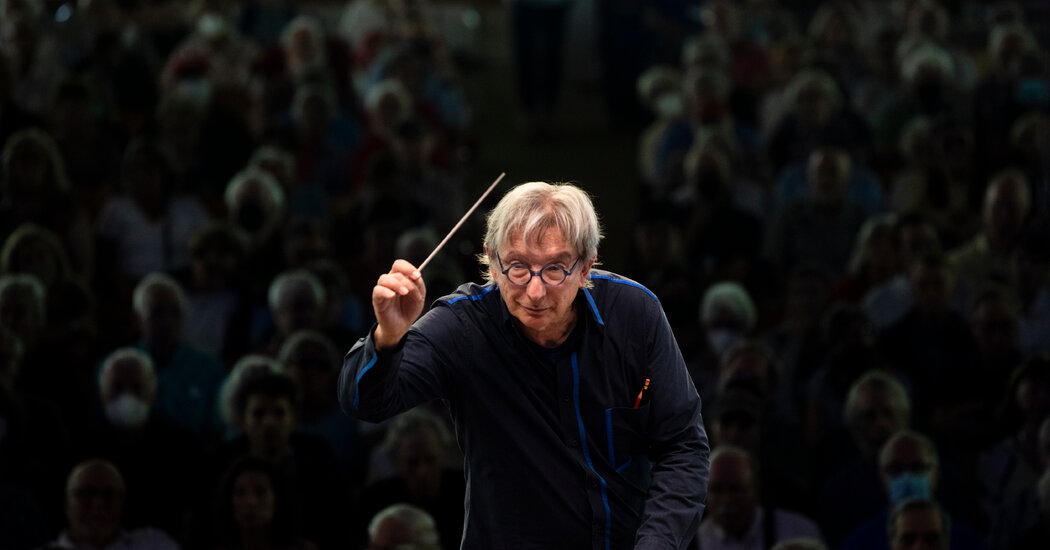
Thomas, who died on April 22 at 81, was a master of genial introductions like this. To many in the Bay Area and beyond, his multi-pronged career — as a conductor, musical explainer, composer, pianist and local luminary — was nothing less than a mold for a 21st-century life in the arts.
His tenure at the San Francisco Symphony, from 1995 to 2020, made the bristling modernism of Antheil and Ives legible through his recurring American Mavericks festivals. He also founded the New World Symphony, an academy in Miami Beach, Fla., that introduced young musicians to the rigors of working in an orchestra. On television, he hosted the “Keeping Score” series on PBS, offering a spy hole into the context and backstage preparation behind repertoire classics.
“Those are some of my greatest memories, actually, watching those,” said the multifaceted violinist Alexi Kenney, 32, who grew up in Palo Alto, Calif., and recently moved to San Francisco. “His educational side was huge for me.”
Thomas’s impact on younger generations of musicians is most palpable through New World, many of whose 1,300 alumni now play in professional orchestras. And he launched many an international career, as an early champion of artists like the pianist Yuja Wang, the director Yuval Sharon and the soprano Julia Bullock, who was still a Juilliard student when he invited her to sing “Somewhere” in “West Side Story” with the San Francisco Symphony.
“He wanted,” Bullock said, “to take a chance on me.”
Thomas set a standard for the role music directors could play in their cities. He lived in San Francisco, sharing a handsomely appointed mansion in Pacific Heights with his husband, Joshua Robison, who died in February. It was common to see them walking their poodles through the nearby Marina District, or hobnobbing with local politicians like Nancy Pelosi and Kamala Harris. During his tenure, the San Francisco Symphony collaborated with members of the Grateful Dead and Metallica, bands with a Bay Area vintage.
“Sitting in Davies Hall next to a bunch of Deadheads reeking of cannabis — it certainly felt different, like something in the culture had changed,” said the composer Samuel Adams, who grew up in Berkeley, with the eminent composer John Adams as his father.
The day Thomas’s death was announced, several Bay Area landmarks, including Coit Tower, lit up in his signature blue, and, unusually for a classical musician, the San Francisco Giants observed a moment of silence.
“M.T.T. was our guy for 25 years,” said the cellist and content creator Nathan Chan, using the widely adopted nickname made from Thomas’s initials. “As a young musician in the Bay Area, I got to experience a consistency of leadership from him that everybody who grew up there will never forget.”
San Francisco had long been ready for a leader like Thomas. Its orchestra had been polished enough by previous music directors to stand alongside other great American ensembles by the time he took over. But he and his Los Angeles counterpart, Esa-Pekka Salonen, went the extra step of fashioning their institutions into cultural labs of sorts, without shorting artistic quality.
“The symphony was not a fixer-upper institution,” Abrams said, “but it was primed for international recognition if it could do something dramatic and different.”
And Thomas — a child of the theater, through his grandparents and parents — knew drama. As a young cellist, Oliver Herbert was awed by Thomas’s semi-staged productions of “Bluebeard’s Castle,” “Peer Gynt” and “Boris Godunov.” Today, Herbert, 28, produces multimedia recitals as part of his ongoing professional studies program in Kronberg, Germany.
“I think Michael is a big part of the reason,” he said, “why I allow myself to think creatively about the concert experience.”
With the rise of YouTube, Thomas was one of the first major conductors to harness its power as a creative and pedagogical tool. He founded the YouTube Symphony Orchestra, which accepted international auditions and produced concerts that were livestreamed to an audience in the tens of millions.
That project brought Mason Bates, the composer of “The Amazing Adventures of Kavalier & Clay” at the Metropolitan Opera this season, to wider renown. His compositions “The B-Sides” and “Mothership” were performed by the YouTube Symphony Orchestra. Bates credits Thomas with bringing his music “to a national audience,” which, he said, led to a commission from Santa Fe Opera for his first opera, “The (R)evolution of Steve Jobs.”
“I mean, this is the guy that premiered ‘Short Ride in a Fast Machine,’ which is one of the most performed new pieces by a living composer,” said Bates, referring to a short work by John Adams. “He gave me specific musical feedback, which not a lot of conductors do.”
In recent years, he sought Thomas’s counsel while composing “Kavalier & Clay.” Bates has also been working to adapt his “Philharmonia Fantastique” — an animated introduction to the symphony orchestra — into a children’s exhibition, and he said that his quest to find creative, immersive ways to reach young audiences bears Thomas’s stamp.
“Michael has been the model for me of how an artist in 21st-century America can bring the deep experience of classical music to everybody,” Bates said.
In his final chapter, Thomas returned, again, to working with young people. He was appointed a distinguished professor of music at the San Francisco Conservatory of Music in 2024, at a time when his public appearances dwindled following a diagnosis of aggressive brain cancer a few years earlier. At the school, he led readings with the student orchestra, coached chamber groups and gave one-on-one private lessons with especially promising students.
The arrangement, made at Robison’s urging, was mutually beneficial, said the school’s president, David Stull. Thomas would remain intellectually active, and students would have the chance to learn from someone who had shaped San Francisco’s musical culture.
“He knew that he needed to rest and conserve his energy, but he wanted to work,” Stull said. “We’re the last generation to work with him.”
Since Thomas’s death, Abrams has spent time dwelling over Thomas’s letter. It’s framed in his bedroom in Louisville, where he lives full time — yet another way in which he has followed in his mentor’s footsteps.
Abrams has also returned to a detail at the end of “Viva Voce,” Thomas’s 1994 as-told-to memoir written with the British music journalist Edward Seckerson. In it, Thomas describes getting a palm reading abroad.
The fortune teller told Thomas that he wouldn’t start doing the thing he’d be remembered for until his 50s, he recalled. He was 49 and on the eve of his move to San Francisco.
“Whatever it is,” Thomas said, “it’s about to happen.”