Subscribe to our Newsletter
It is impossible to discuss the contributions and importance of Luis Miguel Valdez without also discussing the genesis of the theater troupe he founded in 1965: El Teatro Campesino (the Farmworkers Theater). El Teatro Campesino is one of the longest-lasting theater companies of its kind in the United States, and both Valdez and the Teatro continue to inspire Latine theater artists and filmmakers across the country and abroad. So, let’s go back in time to consider the living and working conditions that prepared and propelled Valdez to accomplish his dreams of social justice for the farmworkers, as well as urban Mexican Americans and the working poor of all backgrounds living in the United States.
Valdez’s early performing years
Born in 1940 in a farm labor camp in Delano, in the heart of California’s rich agricultural San Joaquin Valley, Valdez experienced firsthand the hardships and struggles of the people who plant and harvest the produce that feeds the nation. Indeed, he worked in the fields as a child until he was 18 years old. Therefore, his early schooling was constantly interrupted because his family had to follow the crops from season to season and farm to farm. But these relocations did not destroy his creative spirit, nor his inquisitive mind, which was unleashed when the young student began to entertain other children and parents in the labor camps as they all rested from a hard day’s work in the fields. In elementary school, a kind teacher introduced him to papier-mâché and he learned to design and create puppets. He also learned ventriloquism, creating scenarios in which he would create a voice for his puppet and carry-on a conversation with his “friend,” to the delight of his audiences.
RELATED POST
The young Valdez was also inspired by Mexican traveling theater troupes, called carpas for the tents in which they performed. The carperos (carpa performers) would stage variety shows and comic sketches, all of which resonated in the young Valdez’s imagination. His aesthetic choices were also inspired by the legendary Mexican comedian, Mario Moreno, who began as a carpero and created the character of Cantinflas, who was often referred to as the Mexican Charlie Chaplin, the underdog who always got out of precarious situations by his wits.
Despite the fact that his early education was sporadic, he was an excellent student and earned a scholarship to San Jose State College, where he eventually majored in English and was introduced to world theater history. This education led him to write and direct his first full-length play, “The Shrunken Head of Pancho Villa,” produced in 1964 by San Jose State College. That play was written in an absurdist style, peppered with Spanish but mainly in English. Most importantly, this was the first play by a Mexican American, about a Mexican family living and working in the U.S. This experience was a turning point for Valdez, encouraged by his professors to continue writing about what he knew best. The following year, he worked with the San Francisco Mime Troupe, a Marxist theater collective that adapted the Italian style of Commedia Dell’arte, using masks, stereotypical characters and much physical movement along with songs, performing for free in the parks of San Francisco. It was there that he learned the efficacy of street theater to educate audiences about any number of sociopolitical issues: the Vietnam War, the call for the Civil Rights for all peoples, etc. A Chicano Movement had also sparked demonstrations during the 1960s, causing walkouts by high school students demanding a better education and preparation for college in the Mexican American communities. The term Chicano became a popular way for activists to identify; neither Mexican nor American, Chicano or Chicana was a declaration of a unique identity. As Valdez put it: “We didn’t cross the border… The border crossed us!” A declaration that resonates to this day, as brown people are being told to “Go back where you came from!”
The birth of El Teatro Campesino
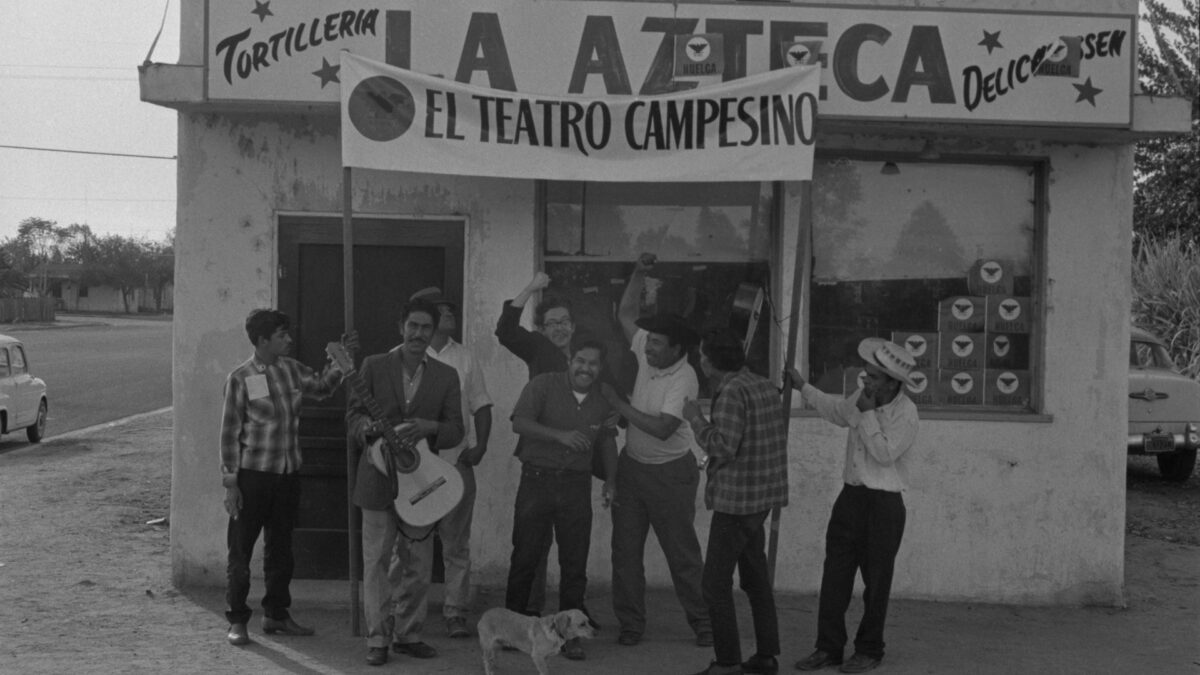
When Valdez heard about the farmworkers’ union being formed in his birthplace, he returned to Delano. Full of youthful energy and excitement, Valdez hoped to get permission from the union leadership to form a theater group much like the San Francisco Mime Troupe, while addressing the critical issue of supporting the union’s efforts to educate the striking farmworkers to leave the fields and join the strike. The union leader, Cesar Chavez, was skeptical, reminding the eager young Chicano that most of the farmworkers had never even seen a theatrical production, much less acted on a stage. However, he was encouraged by Dolores Huerta, vice president of the union, who gave him the green light. Signs were posted around union headquarters that a theater was being formed. A small group gathered in a house, curious to hear what this former campesino (i.e. one of their own—not a city-slicker), would propose.
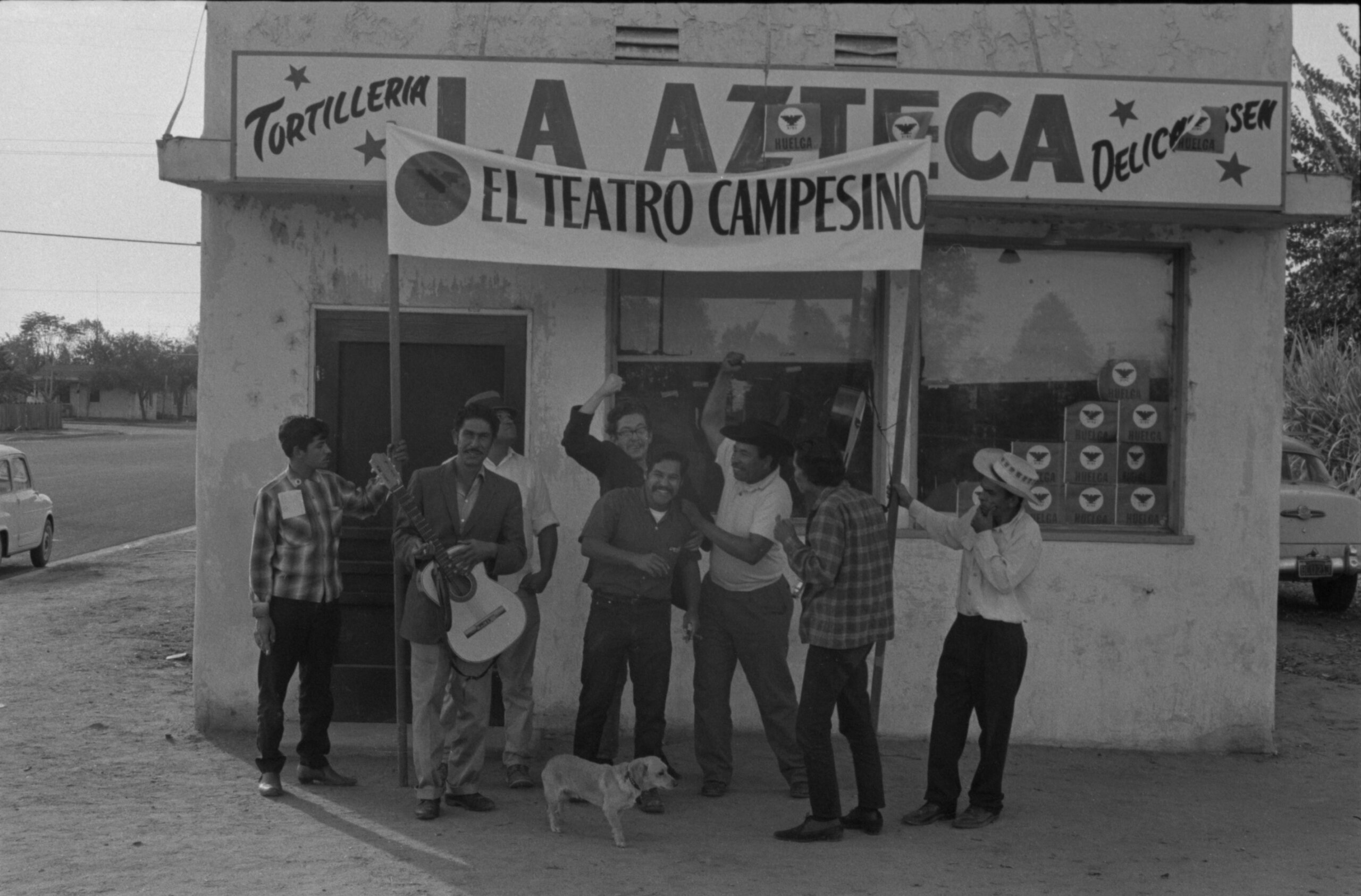
Luis Valdez (center), 1966.
Valdez had brought masks and signs to hang around the “actor’s” necks, identifying a character type with the names of the heroes and villains. He became the artistic director as well as resident playwright for this raggle-taggle troupe of striking farmworkers, guiding them in the collective creation and performances of brief commedia-like sketches which he termed “actos,” dramatizing the need for a farmworker’s union. The actos were modern morality plays, depicting the struggles of Good (striking farmworkers) versus Evil (the growers and their henchmen). The actos were simple but not simplistic, as these non-actors performed at the edges of the fields, urging their contemporaries to leave the fields and join the union. Humor was essential to these performances as the Teatro members satirized the (white) wealthy growers wearing pig masks as well as the (Mexican and Filipino) strike-breakers, called “scabs.” In an interview published in 1967, Valdez said: “We use comedy because it stems from a necessary situation—the necessity of lifting the morale of our strikers… This leads us to satire and the underlying tragedy of it all—the fact that human beings have been wasted in farm labor for generations.”
Working with people who had never seen theater of any kind, Valdez guided the striking farmworkers to improvise conflicts and crises they had experienced on the picket line. The goal was to perform these actos singing strike songs and satirizing the growers and their henchmen in order to dissuade nonunion members from crossing the picket line. During this early period, the Teatro’s aesthetic could be described as “rasquache,” a Mexican colloquialism that can denote something “funky” or “unsophisticated.” By 1967, the Teatro began to tour beyond the fields to other venues including union halls, colleges, high schools and community centers. Most importantly, Valdez and the Teatro would go on to inspire others, mainly college students, culminating in a national network of Teatros inspired by the Teatro’s actos. In 1971, Valdez and the Teatro published the actos the group had created between 1965 and 1971, giving other emerging teatros the rights to perform the actos in the anthology free of royalties. These early actos are still very effective in their purpose: persuading people to support the union’s efforts by boycotting nonunion grapes, for instance.

RELATED POST
***
In conclusion—there is no conclusion because the work continues. There are theater artists, theater companies and scholars across the country producing plays, teaching, publishing articles and books about the movement that can be traced to a group of striking farmworkers fighting for their rights as human beings. In the words of Dolores Huerta: “Si se puede!, Yes we can!”