
I intensely dislike Alejandro G. Iñárritu’s latest epic cinematic offering, Digger. I also love it. I wouldn’t sit through it again. I am pleased — if not a little shocked — that it exists. It will flop at the box office. What a grand, ballsy gesture this is: essentially, a $125M cinematic play. People will laugh with it, laugh at it, contemplate its themes and layers, compare it to Dr. Strangelove and Don’t Look Up, among many other “similar” films. Yet this one is truly unique: in its pomposity, in its brashness, in its go-for-broke pursuit of meaning, in its farcical interludes, in its narrative structure. Love it or hate it, Digger will stand the test of time. Hours after watching it on a massive screen, it still lingers in my head, certain images and moments of Tom Cruise’s towering central performance haunting me.
Cruise plays the titular oil tycoon Digger, who’s faced with a dilemma — or less a dilemma than a catastrophic consequence of all his, ahem, digging in the polar caps. As advisor Ganesh (Riz Ahmed) points out, we’re way past the CO2 problem; the methane split the ice, the rig exploded, and now a giant chunk of frozen water speeds towards northern Europe. Digger fully acknowledges his role in the disaster, meeting with the eccentric President Compson (John Goodman), who’s dying from an anal affliction I’ll leave you to discover. Together, they witness the disaster spread and cause another, even worse one. Eventually, Digger has to defend himself against “the people.”
There is one huge spoiler that I suspect most readers already know about but which I will refrain from divulging, due to its significance. It occurs about 20 minutes or so into the narrative, drastically altering the viewer’s perspective of the unfolding events. Once revealed, the momentum either kicks into high gear for some folks, or screeches to a halt for others. The trailer wisely avoids even hinting at this foundational… shall we say, “narrative quirk.”
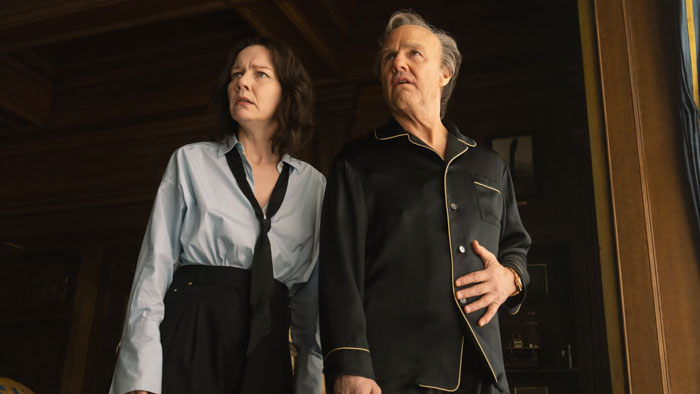
Emma looks on in alarm beside a man in black silk pajamas in Digger.
“…the methane split the ice, the rig exploded, and now a giant chunk of frozen water speeds towards northern Europe…”
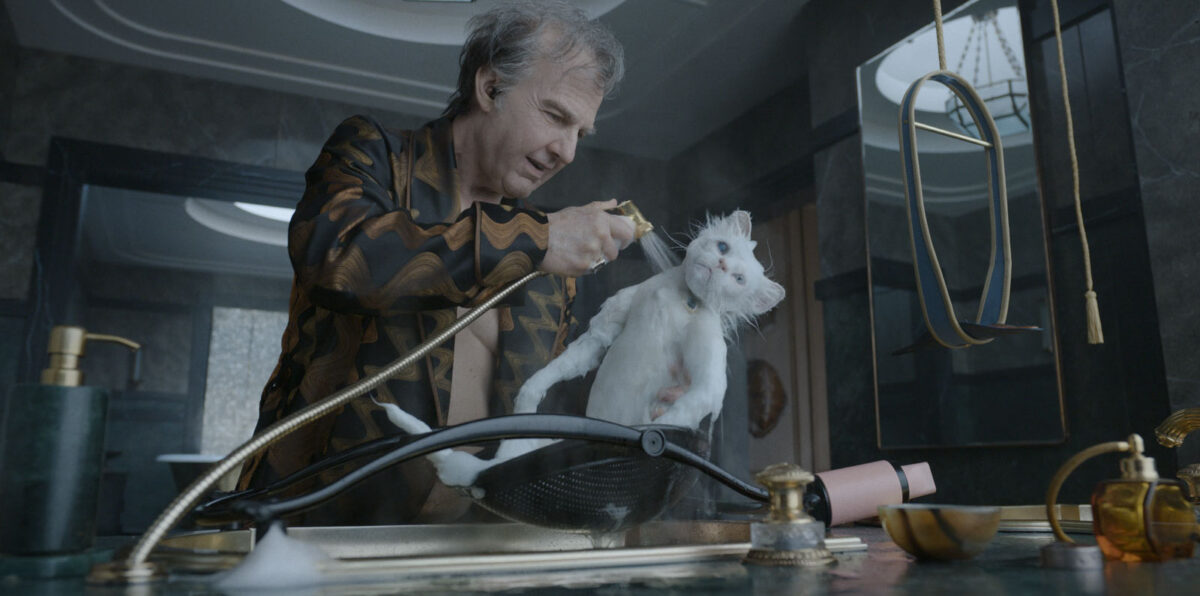
Everything is heightened to the extreme, on purpose. Digger’s cat is purposefully fake-looking. John Goodman is purposefully chewing scenery as if it would help him gain back the weight he lost. Sandra Hüller is not far behind, purposefully accentuating each word as if reciting the script. Legendary cinematographer Emmanuel Lubezki’s camera is purposefully positioned below most actors, in close-up, making them seem both grandiose and puny, spouting toxic rhetoric right into our faces. And the themes are purposefully grand, on-the-nose, smacking you in the face with Digger’s shovel. We’re way past the Rubicon, Iñárritu ultimately says, and all we can do is point fingers and laugh at the bloated morons who caused our demise.
Tom Cruise goes all in. It’s difficult to imagine another actor tackling this role with that level of fervor and dedication; against all odds, it’s a surprisingly good fit — call it “Cruise unraveled” — we’ve seen hints of the showmanship in Magnolia, but here it’s all Cruise, all the time, and boy, does he hold the screen. The “judgment hall” sequence alone, with Lubezki swirling around the actor as he pleads his case, going through multiple levels of intensity, provides a masterclass in film acting.
It all becomes too much, nails on a chalkboard, distinctly unpleasant for a reason I’m still attempting to discern. The production’s pompousness, the repetitive dipping in and out of reality, the juvenile speechifying, the claustrophobic (albeit wildly inventive) set design all make it a squirm-inducing experience, and yet… And yet, Cruise’s performance, Riz Ahmed’s earnestness and justified fury, Iñárritu’s inarguable directorial mastery (for example, his choice to show just the reaction shots to horrific global events) all pull it together into an experience, something that breaks the mold.
I’ll take a film like Digger over Spider-Man: Brand New Day, any day, brand new or not. It takes place in that dreamlike liminal zone between cinema and theater, art and entertainment, character study and cautionary tale, farce and drama. It says less than it thinks, but it resonates more than you’d expect. As I watched Iñárritu’s characters spew venom in ostentatious rooms that literally split at the seams, leaking water, crumbling around them, I couldn’t help thinking: “This is real art. I love it. I also desperately want to leave the theater.”