
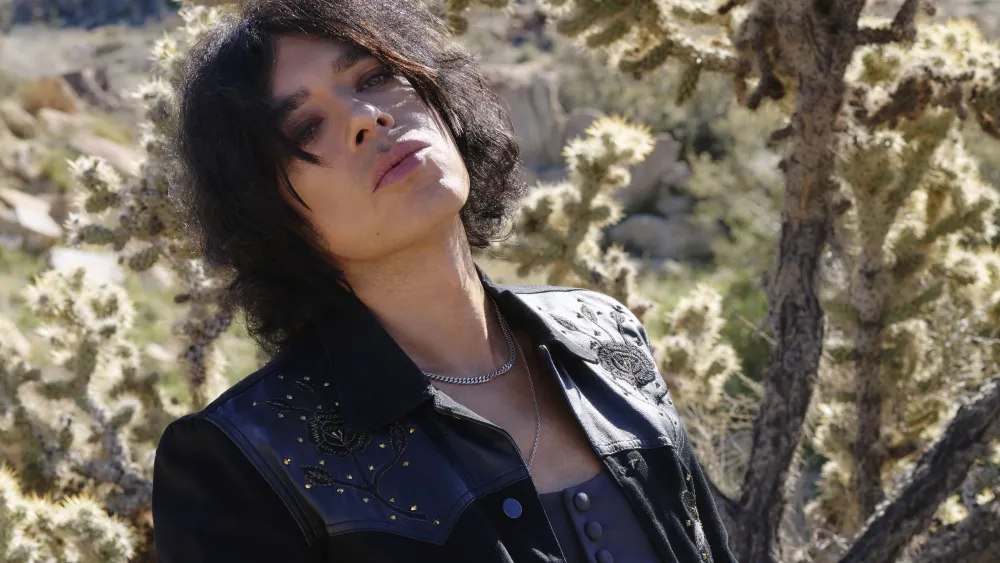
Lawrence Rothman has a lot of nerve, starting an album with a song called “The Meaning,” and then daring to ask some of the questions inherent in the big picture created by those two words — like, if not what is the meaning of life, then what is the meaning of music? (Of course, for a lot of musicians and music lovers, those two questions might as well be synonymous.) But thoughtfulness and intent are never far away from Rothman’s music, or at least hasn’t been since they made a shift about five years ago toward recording in Nashville and feeling the embrace of the Americana community, as opposed to drifting through a series of rock ‘n’ roll bands and personas in L.A. for a lot of years prior.
“The Meaning” kicks off Rothman’s new album, “Here Lives Love/Sawdust to Stardust,” which they consider the completion of a trilogy of Americana-rooted albums that tell the story of the singer’s life and career to date. (Rothman suggests the music being formulated for the next album actually has more of a jazz flavor, though they’re convinced that belongs as much in Americana as the acoustic singer/songwriter material being emphasized at present.)
During the recent AmericanaFest in Nashville, Variety sat down to talk with Rothman not just about wrapping up the fruitful trilogy with “Here Lives Love/Sawdust to Stardust” but about a rich and growing side career producing other artists, including Amanda Shires‘ 2025 confessional album “Nobody’s Girl” (and “Take It Like a Man” before it), Maggie Rose‘s vivacious “Half Moon” and Tift Merritt‘s comeback, “Sugar.” When Rothman begins the new album asking the most core question of them all, “Why am I breathing?,” any of these albums — the ones produced for others, and their own new one — offers a substantial and worthy enough answer.
To ask first about your production work: You work with a lot of great singer-songwriters, and there’s a lot of versatility in the types of sounds you get with different people. No one would mistake an Amanda Shires record for the Maggie Rose album you just had come out.
I don’t know if it’s the Gemini in me, but I’ve loved so many different types of music. my entire life. So to produce and to be able to add sounds, textures and treatments to things that are in a new style every month — because I produce something once a month — helps keep me alive, really, and eep my inspiration up. Amanda Shires makes poetic songs that are just these heartbreaking stories, done in a way that’s so classy, and like Leonard Cohen. It is such a great thing to immerse myself in, because I love sad music, and she definitely makes some beautifully sad songs. You can do that for a while and you’re in that zone, and then it’s great to be able to pop out and do something like Maggie Rose, where it’s more of a celebratory thing of being a mother and this new stage of her life, where it’s about a weird youthfulness in the energy a family gives back to you. T hat record feels very celebratory, and very different than the Tiff Merritt record I made earlier in the year, which was more of a look at the life of an artist, much like myself — what I’ve gone through and what she went through, in a heavy lyrical mode.
I’m a little Method when I produce. I have to feel like I’m in the band. As a sensitive artist yourself, when you’re with all these musicians and you’re getting Method with them, you can lose yourself in it and start to feel a bit like you’re taking on everybody’s trauma. So it’s nice to be able to go amongst these groups of musicians that I work with who telling their truths and spilling their drama and their sadness. They’re all such great people that when you leave those sessions, it’s almost like you’ve been acting in a film, crying and singing and laughing with them, and then at the end of it, you can walk away like yourself again. And I feel like all those artists that I work with, when they’re done, it’s like a clean reset. They got it out of them. I got it out of myself. It’s like a little bit of a demon that you dance with, when you’re producing things.
Lawrence Rothman
Mary Rozzi
How do you make yourself “part of the band”? Is that literally through playing an instrument as part of the sessions?
Like I said, I like to be immersive with it, and I don’t want to feel like I’m the producer behind the glass. I stand in the recording room, not the control room, when I’m producing. If a singer’s singing, I’m right next to them. Sometimes I’ll take my shirt off and dance. I’ll do whatever it takes to get it to have an energy. Because there’s something so clinical, almost like a doctor, about being behind a glass, and they’re in the distance — it just feels odd to me. So I’ve never been one to not just immerse myself physically in the room. If I’m not playing something, I’m tapping something or just getting people to get going.
You’ve talked with liking having women’s voices on your own albums…
I like to frame my voice. My voice is so low that a woman’s texture, or that range, always complements my voice well. So for this record, I have Amanda and Jillian Jacqueline and Katie Pruitt singing on some song, and I got to sing with Sarah Klang (as a duet on “A Fire Test”).
The artists we were just talking about you producing recently — Amanda, Maggie, Tift — are all women. Not that that would be solely your focus, but do you find you gravitate toward women artists more than others?
Yeah, I don’t look at it like that at all. I have to just love the music. And I’m not doing producing to become a millionaire of any sort. I’m doing it because I want to help this singer express what they’re doing in a way that feels like, are we pushing the envelope in some direction that’s forward? And with Americana music, funny enough, I think it’s the most forward-thinking music of any genre right now — because you can be R&B, you can be rock ‘n’ roll, singer-songwriter, folk, you can even be a little bit jazz, and it’s all accepted in the community of Americana. And I think the term Americana is being reinvented as different than what it started as. and now it’s the place for people who want to take all the styles that have sort of, I guess, begun in America or become more mainstream through American culture, and mashing them up to be something that’s uniquely its own.
I think some of the freshest and most exciting music I’ve heard in the last five years has come out of the Americana quote-unquote “scene.” So I find myself working and producing a lot of artists that are under that umbrella. But to me, they’re also all, like, either a rock ‘n’ roll artist or someone like Maggie Rose, who is like soul meets singer-songwriter. So when you’re asking me about, is it women, or… For me, I think right now it’s that it has to resonate in a way that’s pushing genre forward. And if we’re gonna still use use those genre terms like Americana, pop and alt rock, Americana is the place where I feel like you can kind of be anything. I wouldn’t be shocked if somebody put out a space-dance-country-folk record. You can kind of be anything in it and you’re welcomed into the party, as long as the thing that ties it together is the music’s played by real people. There’s great lyrics, whether it’s storytelling or more abstract. And I’m not anti-AI, but I feel like gives the identity to Americana music is that humans created it all. It’s the human touch music.
You have come to feel very comfortable in Americana, though it’s not at all where you started. And with your new album being pretty acoustic, you’re pretty in the pocket with that at the moment.
Yeah, the last three albums, I’ve pretty much focused on that, and that’s been the community that’s welcomed me, so it’s the one I want to identify myself with and support. But if I want to go make a jazz record for the next one, I’m gonna go make it. If it’s called jazz or Americana, I don’t really care. It’s come up a lot that it’s been hard to label what I do, and that’s fine with me. I love Beck, and Beck’s hard to label as well. David Bowie, I don’t even know what the label of that music would be, you know?. He started as a folk artist, and then was a rocker, and then was a pop star, and then was kind of an abstraction star.

Lawrence Rothman
Mary Rozzi
You met and talked with David Bowie, and he had an impact on your thinking about things,, right?
I met David Bowie early on when I was starting my solo career. I’d disbanded my band with my brothers called Living Things that we were doing for 13 years, and I was exhausted. I’d met David Bowie, and I had a song that I had just written called “Montauk Fling,” and I showed it to him. I said, “Hey, I think I’m starting this new chapter of my musical existence, and what do you think of this?” Because it was very different from what I’d done before. And he listened to it, and gave me some great advice. He was just like, “The chorus that you’re singing about there, and the verses, do you mean it?” And I’m like, “Well, yeah!” And he’s like, “But what’s the meaning of it?” So I had to explain it to him. And he’s like, “Well, I don’t think you hit the meaning of it. You need to be more direct.” And so I went back in and rewrote that chorus, and I was very direct. The chorus (ended up being) “Why do you want to fuck like strangers?” I got right to the meaning of what I was trying to say. But that was a really interesting exercise from such an icon, because I had never really looked at David Bowie’s lyrics as I do Leonard Cohen’s per se.
At that point he was about to do “Blackstar,” and when you listen to that record, it’s very much him, autobiographical. He’s about to die. And so I guess he was at a point of what is the meaning of all of what we’re doing in art? — and he was examining it in his own self with “Blackstar.” And I wrote that down in my journal at the time: “David Bowie says, ‘What’s the meaning of all of this?’” It led me to start writing this song called “Glory,” which was on my album “Good Morning America.” A lot of people responded well to it, so when I got to this new record, I wanted to keep exploring what Bowie had said with that. I started the record with the song “The Meaning,” because it’s like, what is the meaning of me putting out music, or any of us putting out music? It’s very ego-driven. As a musician, you’re out there playing rock star — or you’re not, and that’s also playing rock star. If it’s all performance, what is the meaning of doing any of it? With him, I felt like I got to a result of, like, the meaning of doing any of it is just to tell some kind of solid story that somebody can understand, that when they’re going through it, they can go, “That’s pulling me through this hard time.”
For Bowie with “Blackstar,” obviously that was cathartic to write about death because he was dying. With “The Meaning,” I wrote about, why am I putting this album out right now? Why am I doing this music? I’m doing it because it’s my primal scream. It’s my therapy.
You are calling this album, “Here Lies Love/Sawdust to Stardust,” the conclusion to a triology, which began for you with 2021’s “Good Morning, America” and had its middle part with 2024’s “The Plow That Broke the Plains,” which we previously discussed for Variety. Why do you think of them as a trilogy?
Henry Miller is one of my favorite writers of all time, and his his trilogy called “Sexus, Plexus and Nexus” was in my psyche my whole life. I thought, “One day I want to make a record that has the feeling of that, as far as telling a story across three pieces of work.” So when I went into the first record, “Good Morning America,” that was the clean slate. I said to myself, “I’m gonna do this trilogy now, starting with the South,” and it brought me to Nashville. I knew that I wanted to get back to letting songs and lyrics be the forefront of what I was doing as an artist; less so, production, because I had been doing records where I felt the production was kind of the centerpiece. I had gotten to a stage in my life where storytelling and the lyrics and presenting things that were the true me. At the beginning of my career, I was nine different people. I used prosthetics and I had nine different names and I performed different concerts as different alters, as I called them. I did that for seven years and it kind of just overtook my whole lifestyle. So at the top of that 2021 record, I wanted to get back to “this is what I’m going through” on the page with some chords behind it.
So the start of the trilogy was with that idea, and I connected with Lucinda Williams, who has been a huge influence on my life on every level. On that record, she sang with me on a song called “Decent Man,” and that brought me to Nashville. I’d come here as a kid to record, I fell back in love with the city and the scene, and then that record just sort of dictated where I was gonna go. I started writing more songs from that record that appeared on the last record, “The Plow That Broke the Plains,” and then a few of those songs I wrote during that period have appeared now on this one. I brought back some of the same collaborators throughout the three records. Katie Pruitt is on the first one, and now she’s on the last one with me. Amanda Shires is on all three. And Jason Isbell is on the last one and the new one. We wrote a song called “Nothing Like Shakespeare” together in the same three hours that we wrote a song off my last record called “Poster Child.”
Both of those songs, “Nothing Like Shakespeare” and “Poster Child,” sort of tell my origin story. “Poster Child” tells the story of what I went through as an artist at a young age, being signed at eight different major labels and getting dropped and getting signed again, and them sort of using my story as fodder for press and things like that, and how I felt like I got a little bit taken advantage of. “Nothing Like Shakespeare” is how I got to L.A. to get that first record deal. I lived with this girl who was the first love of my life, and we broke up when we got to L.A. In the lyric, I say, “I took the bus, she took the house,” because that’s what literally happened. I got a new record deal with a band with my brothers, and I’ll never forget the bus pulling up at our house, and I came out with everything I had, and it was done.
So, that’s the backstory with the trilogy situation. I hope one day people have the attention span to sit with it and listen from song one, which was “Thrash the West” on that first record in 2021, to the final song on this record, which is “Sawdust to Stardust.” Because basically that is the opening and the ending of this sort of filmic record that I’ve made that tells my complete adulthood story of the trials and tribulations I went through and how I got into music.
Is it a cathartic story, overall?
You know, it’s been a painful experience being in music, I’m not gonna lie. But it’s something that I can’t live without. Every time through the years that I’ve gone “I give up,” the next morning I wake up and I’m at the piano or guitar. My wife laughs at me about it because I give up, like, once a year. But I can’t get away from it. I’ve been on stage playing music since I was 8 years old; got my first record deal at 16. And it has more to do with the act of creation than it has to do with the fame or the fortune. I always say to my wife, “You can’t have a little hallelujah without a little hell.”
I’ve been on this journey a long time, and I’ve never gotten famous, and that’s never been my goal. There’s a lot of expectations you get from family members and things like that of like, “Why don’t I see you on late night TV?” Or “Why aren’t you over here on the radio?” That’s part of what I call the stress pool of making art, is the expectations of your audience, of your family, of your friends. For me, art’s always been about the act of creation. I don’t really care about who likes it or who doesn’t. There’s many people who only like my first album that I did, which was very indie pop, and all this newer singer-songwriter stuff, they don’t like. I lost probably thousands and thousands of fans, but I don’t care. It’s not why I’ve gotten into this. … When you’re in the mercy seat as a musician, and there’s all this expectation, regardless if you’re famous or not famous, but you always have a fan base. And I just find I have to stay true to myself, and with that brings a lot of hell, you know?
I don’t think I can really write stories about other people. Unless it’s a friend of mine and I’m observing it, it has to be something connected to me. Those types of writers that can just kind of observe from afar and write about it, that to me is more like work, and I can do that for other people, because I write a lot for other people. But for me, when I’m writing my own songs, if there’s not some weight behind it that’s resonant with my real life, I feel like it’s empty words. So it’ll always be autobiographical, I think. But hopefully, next time, I’m thinking it’s gonna be happy. Maybe I’ll have my Bobby McFerrin moment, you know?
Going back to the song “The Meaning,” a press release said you were donating proceeds to the Trevor Project. Why that cause?
I’m doing a portion of my whole album for it, but for that one song, I’m giving the full. If let’s say it got synced in a movie or something — which is hopefully what will happen; Madi Diaz and I originally wrote it for a movie that got shelved — I’m giving the full fee to the Trevor Project. You know, growing up being torn apart to pieces daily, it’s part of why I moved to L.A., because it was a little bit more acceptable to just be yourself. So I feel like I want to support what they’re doing as much as I possibly can. I’m not a rich person, but, I do put out art, and I can afford to help in the way that I can help, which is through my art, basically. And I’ve had a lot of people reach out to me since (the song went online). It’s ticking the box where somebody will listen to it, they’re having a bad day, and it’s lifting them. So I felt like that’s an appropriate song for that cause, because a lot of those kids are really going through it, and the song mirrors that there’s hope, you know? I went through it, and I’m still here. And I’m glad I did. I found meaning in my existence of why I was a little bit different growing up than everybody else. That created who I am today, which is completely unique. Back in the day, people picking on my physical appearance used to kill me. Now I take all that and I just put it in a song. So that’s the meaning of me being a little bit odder than everybody else.
You look like a rock star now, but if that’s how you looked growing up, there are reasons to understand why that might not have been the popular thing. Missouri is not the rock star milieu.
It was a lot of shit. You know, my mom was always the type of person where it’s like, “Be you. You’re an individual. Be yourself.” And I could wear a dress; I could wear a cowboy hat and no shirt with cut-off jean shorts if I wanted. She didn’t give a shit. I could put makeup on, do whatever I wanted to do, so I was always super eccentric. Back then, the word everybody would use was “androgynous.” That was how I was defined in the ’90s growing up, is like, “Oh, that’s the androgynous kid.” Growing up in Missouri, and you get a lot of heat for being not an athlete or at least dressing like an athlete.
To ask about another song on the new album, “Worn Out Woman” — was that inspired by anyone in particular?
I’m glad you brought up that one. Nobody’s asked about that, and that’s one of my favorite ones. It’s about my wife (Floria Sigismondi, known as the writer-director of “The Runaways” and dozens of music videos going back to the early ’90s). She’s a director and photographer, and she’s been doing it professionally for about 35 years, and is highly successful at it. She actually grew up in a time when there were no women directors, and came to work with people from Bowie to Rihanna. As time went on, I could tell that the weight of misogyny in the business of film was hitting her hard. and one night she was in the process of making her upcoming movie and a lot of stuff was being thrown at her. Her mother was dying. I sat at the piano and started to come up with that, and I kept it in my back pocket. I got together with a great songwriter called Amy Wadge (known as the co-author of Ed Sheeran’s “Thinking Out Loud”), who came over to my house the next week. She was like, “Let me hear it,” and afterward, she was like, “I’m gonna cry. That’s me.” And so I said, “Well, let’s write that. Let’s finish that.”
Amy’s got a record coming out, too, and she’s about the same age as my wife. She was telling me the parallel story of how she’s been the head of the family, or the light bearer, and that’s the same with my wife. My wife grew up with her sister and her parents, and she was like the parent. And that, mixed with being a woman director in Hollywood, is intense. She ironically directed three episodes of “The Handmaid’s Tale.” And she did this thing for Sigur Rós where it was like gas masks and art sort of become reality. She was like, “I don’t know about that song. I don’t want that to become my reality, (that) I’m worn out.” I’m like, “No, no! We’re just doing the the primal scream. We’re just screaming out the bad vibes on it and now it’s gone. Now you’re not worn out…” I told her, “I think a lot of other women will feel similar and see themselves in it.” It’s a testimony.
About another new song, “A Word’s a Weapon” — was that prompted by contemporary discourse?
It’s a saying that I’ve said my whole life, actually. I would just be like, your words are weapons and they go cut through me like a knife. I don’t know why it never dawned on me to write it in a song. But the political state that we’re in right now is so loaded and so huge and so even sometimes even beyond my comprehension. The one thing I know for sure, especially in the United States of America, is that people can hurt each other, like on steroids, 10 times more, by the things that they say than actually pushing them down the stairs. It’s really hard sometimes to wash off what somebody said to you, because it cuts harder than a punch or a fall or even getting stabbed. It’s just something that really psychologically changes you. And the way Americans speak to each other is so rancid and vile. I’n this country, I think everybody just needs to wash their mouths off with soap and pick up some books and just relearn how to talk to one another.