

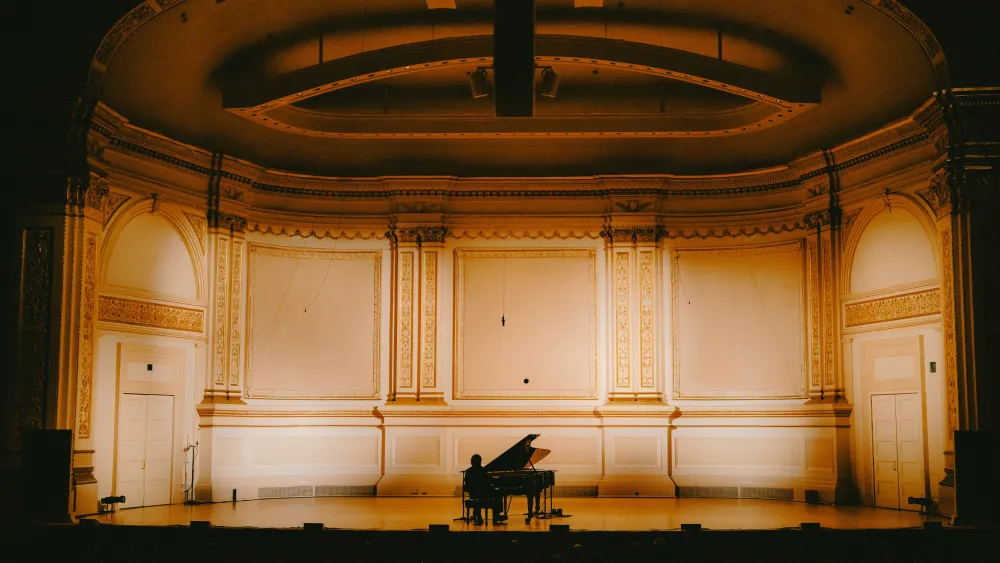
You want a concert movie to sound great, and plenty of them do. But I don’t think I’ve encountered a concert film that casts the precise kind of sonorous spell that “Cameron Winter at Carnegie Hall” does. Directed by Paul Thomas Anderson, the movie, which had its premiere tonight at the New York Film Festival, is a record of the solo performance that Cameron Winter gave in front of a packed audience at Carnegie Hall on Dec. 11, 2025. The movie in only 75 minutes long, and it consists entirely of Winter seated at a Steinway grand piano, singing his gorgeous meditative trance tunes, but I swear you’ve never heard a sound quite like this.
The slow rolling piano echoes through the hall like a rhapsody from the deep. The sound is rich, lustrous, bottom-heavy, grand. And that voice! Winter sings in a low baritone (and occasionally a high one) of astonishing power, the notes hanging there in a suspended quaver so bold it’s hypnotic. At different moments, he’ll remind you of a great many other singers. At times he’s a low-octave Thom Yorke, his lost-in-the-haze midnight rapture is like Tom Waits minus the gravel, and there are strong echoes of early Springsteen — the plaintive bard of “Incident on 57th Street” — in his soaring vocal caress, and the wide vibrato of it. The concert may remind you, at times, of John Cale’s great 1992 live album “Fragments of a Rainy Season.” But the artist the Cameron Winter of “Cameron Winter at Carnegie Hall” is most magically reminiscent of is Bob Dylan — the Dylan who let the words pour out of him in a blissful torrent, and sang them as if possessed. Winter, like Dylan, isn’t just singing. He’s crafting pop songs that add up to an incantation, a rhapsody, a prayer.
At the start of the concert, Winter, very tall, in a black shirt and pants, with shaggy greasy unkempt indie hair (with his thick eyebrows and doleful countenance, he suggests a solemn version of Nicolas Cage in “Leaving Las Vegas”), lopes onstage and stands in front of the piano, introducing himself with what looks like a slight bow, though it’s so reticent it might just be a hipster stoop. Winter, of course, is the frontman of Geese, the indie-band-of-the-moment who, on the tuneful/tuneless scale, reside somewhere between Wilco and Arcade Fire. Geese are okay, but they’ve been overpraised. Winter’s 2024 solo record, “Heavy Metal,” is much more compelling; it gives voice to the meditative soul inside the noise rocker. “Cameron Winter at Carnegie Hall” is a showcase for that Cameron Winter, the chanteuse of sadness and faith.
The piano is poised at a slight angle on the bare Carnegie stage, but basically Winter has his back to the audience. It’s not a hostile gesture; it’s a sign of how much he wants the music to dominate. But a movie is a whole other thing, and Paul Thomas Anderson, directing his second music-performance film (after “Junun,” a 2015 Jonny Greenwood-goes-to-India trifle), has crafted a visually spellbinding movie that’s never showy or grandiose. He frames the piano on the stage from different angles, and he brings us up close to Cameron Winter and right into his emotional orbit. There are stage-eye-view shots of the audience (the four balconies of Carnegie Hall separated by three rows of light), and the whole movie is suffused with an orange-yellow glow, as if all of Carnegie were lit by candlelight. It’s a classical sunset church vibe, and it matches Winter’s music, which is all about mystery and heartbreak, which he sings of with a beauty that makes it inseparable from joy.
I could sit here and pretend that I know what Cameron Winter’s lyrics mean, but the truth is they’re often the kind of suggestive poetry that’s diminished by being overanalyzed. The meaning resides in how he sings them, his passion ringing out like a deep dark bell, with shades of accusation and awe running through the performance. He hooks you from the opening number, “It All Fell in the River” (which I think is about the catharsis of tears), he carries you through “If You Turn Back Now” (a relationship drama that finds room for an inquisition on the devil), and he makes you feel the emasculated belittlement of “$0,” but also the stirring declaration that “God is actually real.” The movie culminates in a performance of “Take It With You” (“I found a keepsake of you by the window in the kitchen, babe,/Take it with you when you leave”) that channels the scalded romanticism of Dylan at his most majestic.
Cameron Winter’s solo songs are often beautiful, but most of them move at the same slow tempo, and they don’t have a verse-chorus conventionality. “Cameron Winter at Carnegie Hall” has the feel of a slow-motion song cycle, like Leonard Cohen’s first album. The movie might have been a touch lugubrious were it not for that voice of Winter’s, which is a miraculous instrument: indie in a low-slung operatic way. In “Cameron Winter at Carnegie Hall,” he’s possessed by the music he’s singing, so lost in it that you hope he’s never found.