

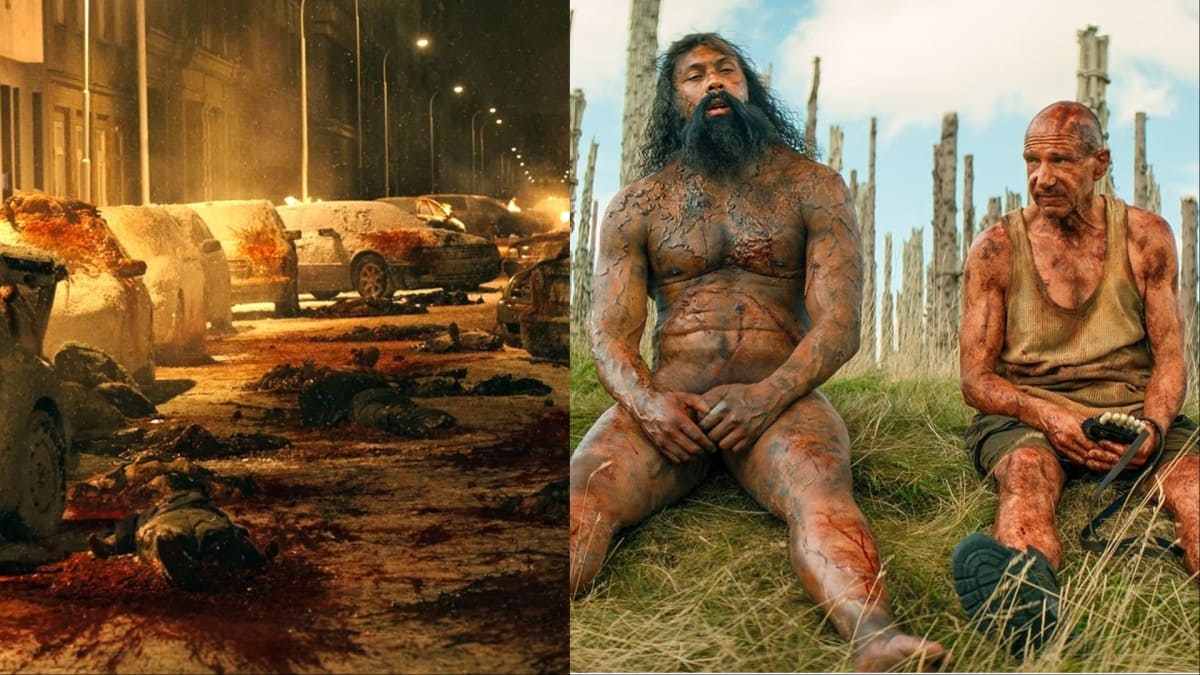
In the first major zombie movie to come out in 2026, a kind (if slightly kooky) doctor sees the humanity inside of a hulking, virus-infected man who has the strength to pull out somebody’s spine with his bare hands. The doctor tries to understand this so-called monster in order to save—even befriend—him, and he’s ultimately successful. Meanwhile, in the most recent zombie movie of the year, a scared little girl in the process of transforming into something horrible begs for help before her face splits open, revealing a single bloody eyeball and a ravenous maw of teeth. The protagonist instantly blasts her to bits with a shotgun; it’s one of the funniest moments in the film.
To say that 28 Year Later: The Bone Temple and Resident Evil represent two different approaches to zombies is an understatement. There are similarities, of course. Both are gnarly movies with gore, shocking scares, and most importantly swarms of people who have been transformed into flesh-eaters by a viral outbreak. (Their zombies are, technically, not undead, though they’re certainly zombies by any reasonable definition.) Zombies are one of the most versatile movie monsters; they can represent an intolerance of an “other,” prey on fears of infection, be a dark reflection of humanity’s own impulses, or they can just be a bunch of spooky bad guys that protagonists can mow down without feeling too bad about it, video-game-style.
It’s no surprise that Resident Evil, an adaptation that captures the experience of playing games like this better than basically any other before it, would depict zombies in this more mindless way. From the moment when the first victim of the t-Virus enters the movie, when she walks in front of Austin Abrams’ car, Resident Evil‘s zombies are treated like props. She’s scary, but she and the other zombies are played for laughs as much (if not more) than they are for horror. Before Bryan, Abrams’ unfortunate medical courier, realizes the true nature of the woman he’s hit, he’s exasperated by her. In her stunned state she reaches over towards Bryan to his annoyance and the audience’s uneasy chuckles. When a cop pulls Bryan over, they both treat her like a burden. As the t-Virus spreads, Resident Evil continues to deliberately ignore the humanity of the infected. They’re no longer individuals—literally, in the case of one multi-limbed monstrosity that fuses itself together with other zombies.