
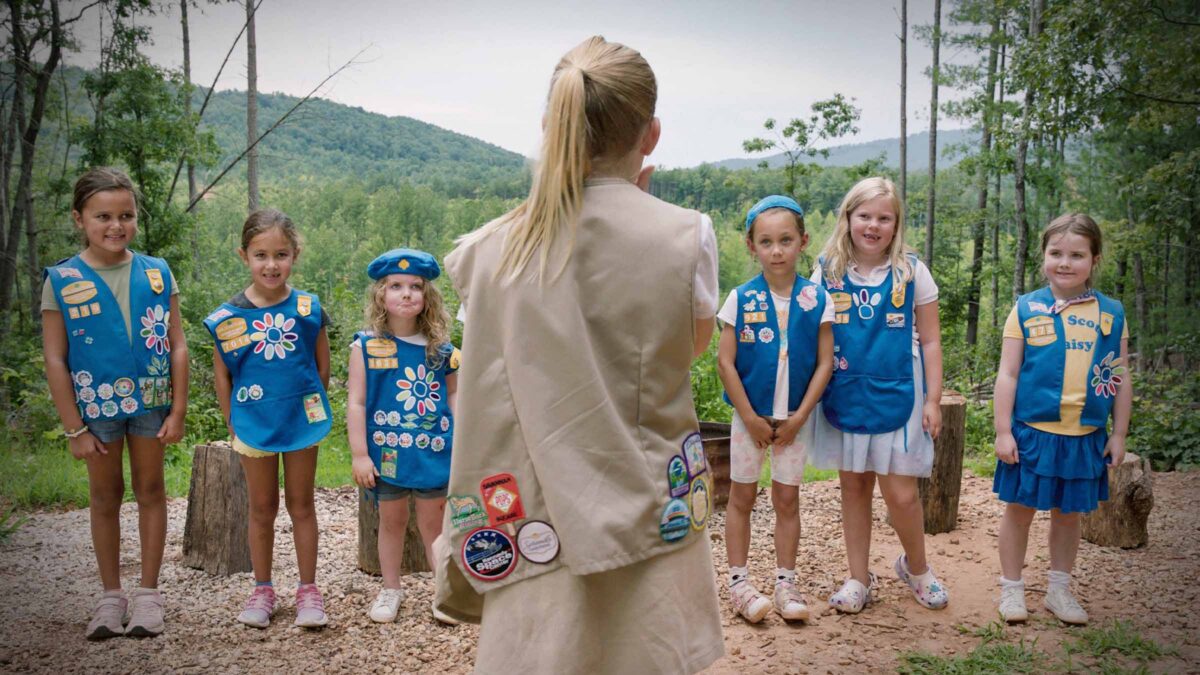
This week we’re seeing something exceedingly rare come to the local cineplex: a feature documentary not anchored by a celebrity or music performance. Hot off of her recent acceptance of the Film Independent Changemaker Award, documentarian and Film Independent Fellow Alysa Nahmias is coming to the big screen with her latest feature Cookie Queens which releases nation-wide August 7th.
The film follows four Girl Scouts over the course of one cookie-selling season, as they push Thin Mints, upsell Tagalongs, and try to reach the goals they set for themselves. Nahmias is known for directing documentaries about the art world like Art & Krimes By Krimes, The New Bauhaus and Unfinished Spaces, but came to the world of Girl Scout Cookies by engaging with her two daughters. She found there was plenty of interesting themes to baked into the idea– including gender inequality, ambition, fair compensation, and the lessons we teach our children about living in a world where everything is for sale. That tension between the lighthearted and the thematically-rich interested Nahmias. “What I found with Cookie Queens was a balance between familiarity and surprise,” she said. “There’s a film audiences might expect from this subject, and then there’s what we actually made. I want to take people somewhere they didn’t expect.”
The bet that Nahmias and her distributor Roadside Attractions is making, is that the sweet hook of watching the girls trying to meet their sales goals will let the film tackle some of these thorny questions. We spoke with Nahmias about her personal connection to the world of cookies, and what a theatrical documentary looks like in 2026.
What was your connection to Girl Scouts and cookie selling, and what drew you to making this film?
My 9 year-old and 11 year-old kids watched the last film I directed, liked it, and then they challenged me to make a documentary that they’d really want to share with all of their friends. Soon after that, my producer told me about a girl who had really impressed him selling Girl Scout Cookies at a restaurant. I immediately knew this was the film I had to make. Not only is the Girl Scout Cookie sale a vibrant visual world full of amazing characters, but the way my male producer described this young woman shifted: first she was “cute,” and then suddenly she surprised him as super smart and savvy. I could see myself in that girl, both from my own childhood and as a woman. There’s sometimes a real gap between how we see ourselves and how the world sees us. In an epiphany moment, I realized that cookie selling was a way into something much larger — girlhood, capitalism, how girls are taught about value and our place in the economy. It was never only about the cookies. I wanted to represent girlhood more three dimensionally than we typically see it on screen.
What was the development and fundraising process like?
Cookie Queens is completely independently produced, funded through grants from Sundance, Ford Foundation, Artemis Rising Foundation, the Harnish Foundation, and others, alongside some independent equity financing. My producers and I pitched the project at the Sundance Catalyst Forum development slate in 2023, where we secured seed funding. That support gave me room to develop my creative approach and dig into references — films that took childhood seriously, that saw kids as complex characters. I was looking at Moonrise Kingdom, The Florida Project, and Petite Maman, for example. That process shaped the whole aesthetic of the film. I decided there would be no sit-down interviews. Everything would be observational, entirely in the moment, and that I wanted to capture the way the girls perform femininity when they’re selling, how that mode turns on and off.
How did you find your subjects, and how did you build trust with the families?
We cast a wide net. Part of the Sundance Catalyst funding allowed us to hire a casting producer, Whitney Adams, who did excellent work with grassroots outreach through parent groups on social media and Girl Scout troop leaders, who are extremely well organized. My producer Jen Sims and I attended the National Girl Scout Convention and spent time visiting families before we ever turned on a camera, just getting to know them, being honest about the commitment and trust that documentary filmmaking requires from both sides.
I was looking for kids who genuinely worked hard at selling, who had real strategies and imaginations, who could be comfortable with a crew and open about their inner worlds. I told them from the beginning: I don’t care how many cookies you sell. I care about what happens along the way, what you discover about yourself or the world this cookie season.
The film spends a lot of time with the girls outside of selling — Olive in her cotillion class, for instance. How did you decide which moments like that belonged in the film?
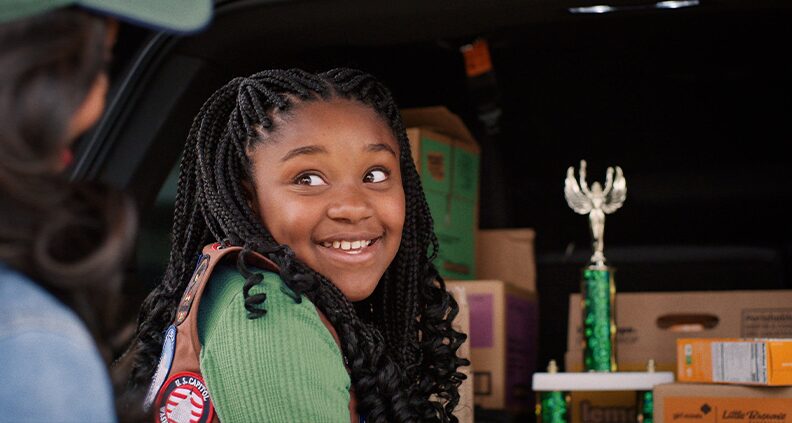
There actually aren’t that many shots of cookies in this film, because a lot of scenes take place with the girls in other areas of their lives. This is a coming-of-age story. Nikki and her sisters spend time together in their bedroom playing with dolls and makeup, and the pressures they talk about with regard to selling cookies are similar to the pressures children might feel about sports or school. We see Shannon Elizabeth learning karate as a way to understand her journey with self-confidence. We watch Ara, who has Type 1 Diabetes, practice selling cookies she can’t eat. To me, that spoke to something much bigger about accessibility. A scene like Olive at her etiquette class tells us what drives her, and that question, what drives these kids, was at the heart of everything. Not just who drives them to the supermarket with their Samoas, but what is motivating them to pour so much of themselves into this commercial endeavor for a company that does $800 million a year in cookie sales.
Can you talk about the editing process and weaving four stories together?
This was my first film interweaving four separate stories. I wanted to make something where the whole is greater than the sum of its parts. I worked with three editors at different phases of the edit — Kim Roberts, Jeannie Applegate, and Fatima De Los Santos — whose different perspectives were invaluable. With Fatima and Jeanne, we identified each Girl Scout’s story arc and key scenes. In the final phase with Kim, we were finding the transitions between stories that said something bigger than any one of them alone.
Documentary gives you things you could never write. Olive’s opening line about upselling — people have asked me if she said that. I just filmed her teaching the younger Daisies about cookie sales and stepped back. I could never invent that line. It’s completely Olive! That’s what I keep coming back to about nonfiction: the world hands you things that are both utterly specific and somehow universal. Finding those moments, the ones that seem small but are actually much larger, is such a joyful part of the work.
The film is getting a theatrical release, which is significant for a documentary. What does that mean to you, and what did you learn from making something with a built-in audience?
I always wanted watching Cookie Queens to be a communal experience, something a family, a Girl Scout troop, a mixed-age audience could share. When we premiered at Sundance in the Eccles Theater, which seats over 1,200 people, the energy was electric. Laughter, tears, applause breaking out in the middle of scenes. That told me this was something worth seeing together in a room.
Roadside Attractions has a strong track record with theatrical documentaries, and the built-in audience is real: Girl Scouts membership is around 2 million current members and over 50 million alumni, and that’s before you count everyone who has ever bought the cookies. But beyond the audience numbers, I think the film earns a theatrical experience through the visuals, the music, the sound design, and my team did extraordinary work across all of those.
As for what I’ll carry forward: every documentary demands that you adapt your entire process, your production approach, your edit, your distribution strategy, to the specific world you’re entering. What I found with Cookie Queens was a balance between familiarity and surprise. There’s a film audiences might expect from this subject, and then there’s what we actually made. I want to take people somewhere they didn’t expect. That tension, I think, is what I’ll keep chasing.
Images courtesy of Roadside Attractions
Film Independent promotes unique independent voices by helping filmmakers create and advance new work. To become a Member of Film Independent, just click here. To support us with a donation, click here.
Keep up with Film Independent…